I think it is time to admit that we are not good at cornmeal porridge. For whatever reason, although we have made countless versions of cornmeal porridge for this blog, they have never really turned out delicious.
We are either not adding enough salt, or too much salt, or stirring too much, or too little, or in some other way just failing to achieve cornmeal porridge Nirvana.
The strongest candidate for the national dish of Montenegro is Kačamak – a cornmeal porridge. The picture on the recipe page looks amazing and appetizing, and this one involves potatoes and cheese, so that’s different! Surely THIS time we will not serve as both Lucy and Charlie Brown, pulling the football out from in front of ourselves yet again.
Let’s find out. However, I’ll lead right now with the spoiler that the OTHER two dishes we made were absolutely delicious, so the meal was still a winner.
Our main dish was to be Brav u Mlijeku, or “Lamb braised in milk.” Here’s the usual family photo of ingredients:
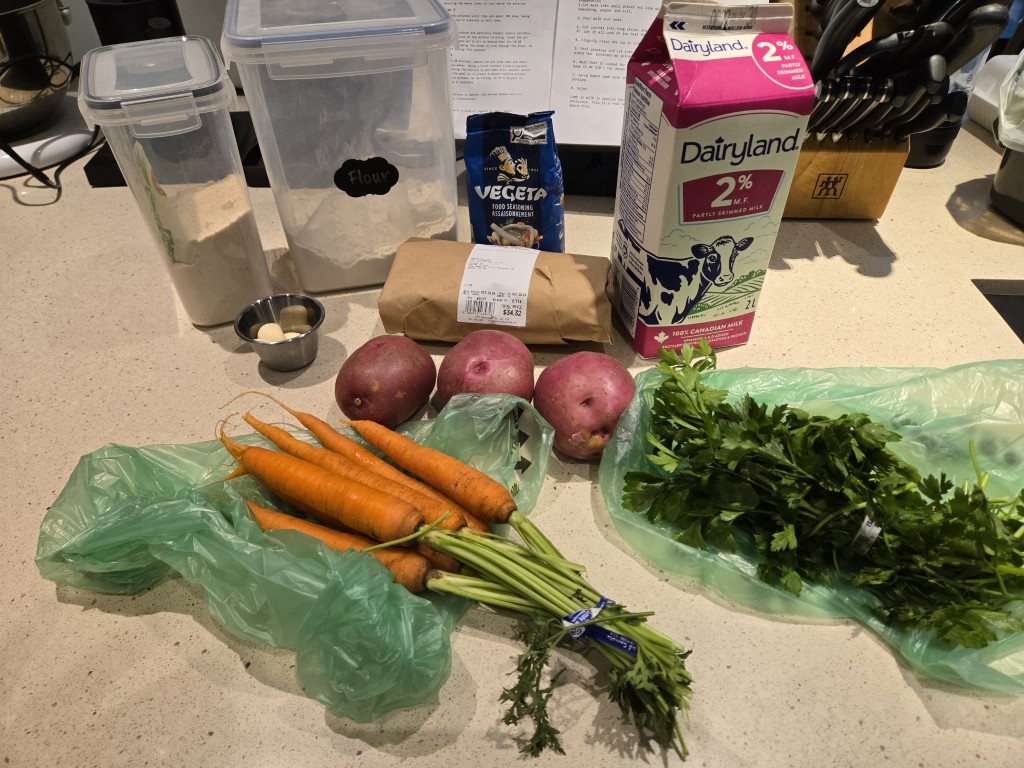
Lamb, check, potatoes, check, carrots, garlic, parsley and milk, check. Also two kinds of flour, but that’s for the other dish. There’s also a bag of “Vegeta”, which is an absolutely essential seasoning in this part of the world, and I don’t quite understand how we’ve managed to make four or five Balkan meals already without buying a bag of the stuff.
It’s basically salt and dried veggies, but it tastes good, so what’s not to like?
To make the dish, we start by braising the lamb and carrots in milk for about an hour.
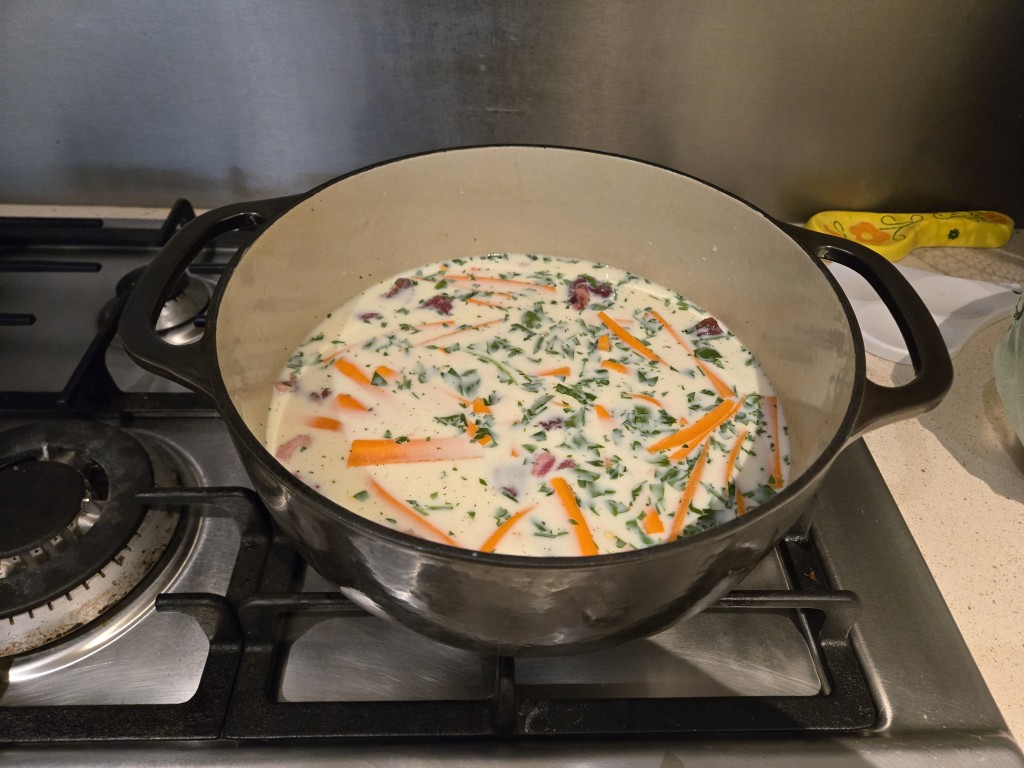
So far so good. And this is where the recipe we made went a little off the rails, I think. Most of the recipes I could find online for this showed a picture that basically looked like this – white broth with cooked potatoes in addition to the veg and lamb.
But ALSO – most of those recipes were from knuckleheads like US, i.e. non-native culinary tourists doing an “around the world” project.
The one I picked was from an actual Montenegran (Montenegrian? Montenegronial?) person. As I am writing this up, I also realized that the blog with this recipe has the subtitle “Sex, Men, Women, and Fashion.” It also has only one entry on the entire site – this recipe. So who knows?
At any rate, THIS recipe has you, now, one hour into the cook time, dump your raw chopped potatoes into a baking dish, pour over the contents of the pot, and put the whole thing into a 400F(!!) degree oven for another hour. It didn’t say anything about covering it with foil, but that REALLY seemed like a good idea, so I did that.
And at the end of an hour at those temperatures, it should come as no surprise that the milk solids had completely separated from the liquid.
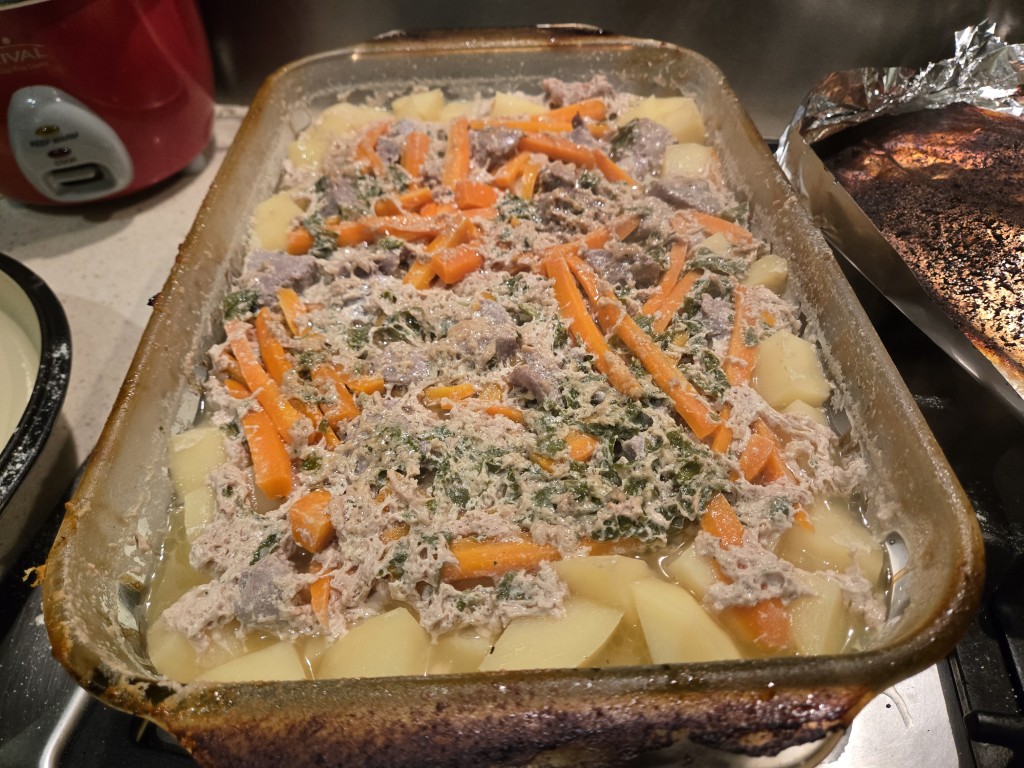
No milky white broth here. Just a somewhat unattractive topping of milk solids, and clear broth in the pan. However, one bite of a potato immediately made clear that we were NOT going to care what this looks like – it was perfectly cooked, and delicious.
OK, so, what about the Kačamak? Well, let’s get to it. Once again, there were a number of possible recipes, and I THOUGHT I had identified one which was semi authentic. But I think it left out some key details.
For example – it didn’t SAY anything about chopping up the potatoes before cooking them. So I didn’t. That was probably a bad choice.
The process it advocates is to cover the potatoes with water and cook them to 70% done. Take your best guess as to how long that is.
Then, and this is the REALLY odd part – you dump a mix of corn and wheat flour on top of the water, cover the pot with a lid, and then just steam the flour until it’s cooked.
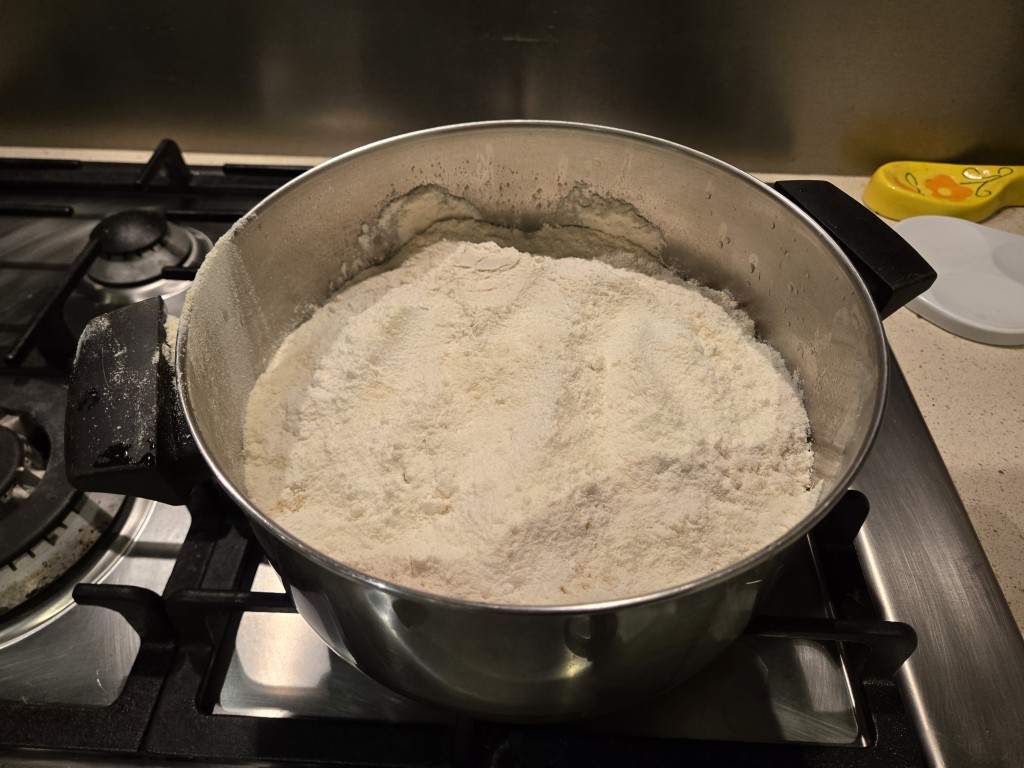
This, frankly, did not work. After the prescribed amount of time, half the flour was still raw, and the potatoes were still fully solid. I kept adding more water and putting it back on the stove. Eventually, I also started stirring the mixture, even though the recipe said not to, because there was just too much uncooked flour sitting on top of the pot.
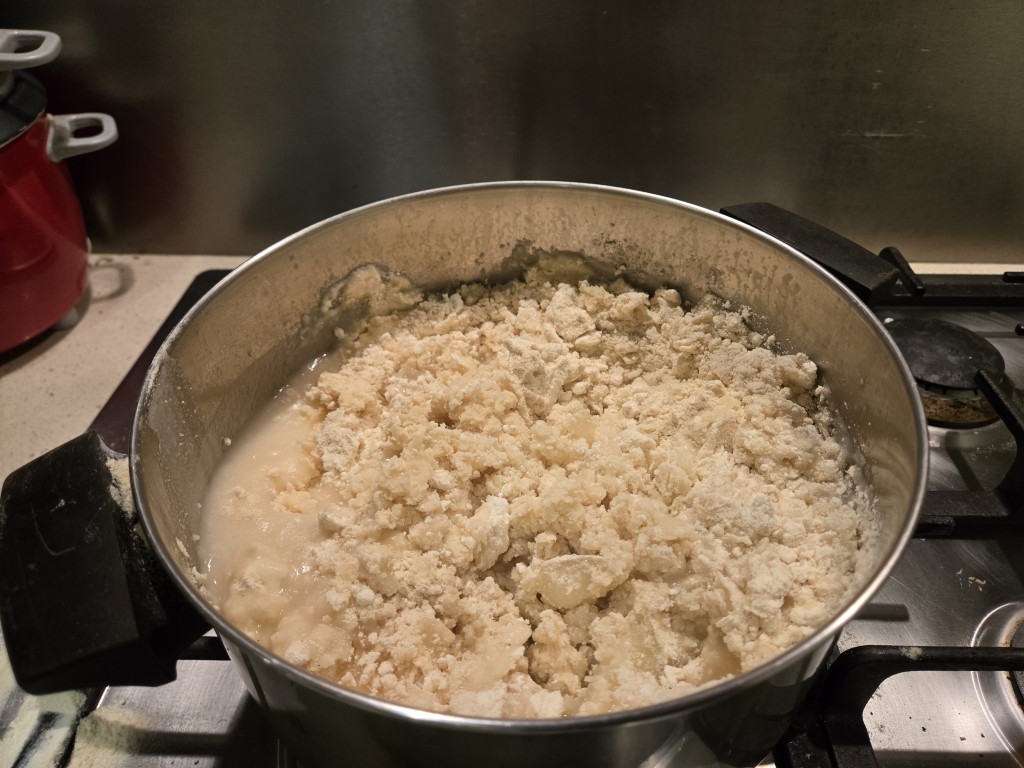
Eventually, after a lot of sweating and swearing, I got everything to a very thick, edible consistency. I then went to add the (wholly unspecified) quantity of cheese that the recipe asked for, and realized that the tub of Macedonian feta I had purchased was more brine than cheese. So that’s on us – I suspect a LOT more salty cheese would have helped here.
Lots more arm day later, and we ended up with something lumpy, but not insanely so, and entirely capable of being eaten. There was just no particular excitement to it, because it was basically bits of barely cooked potatoes lodged in plain dough.
I had purchased some Kaymak (Balkan clotted cream) to go with this, but it was richness without anything interesting to cut, sadly.
Knowing that we were having lamb and porridge, we also made a chopped salad. These are also quite normal for the region, although I don’t think there’s anything particularly Montenegrin about this one.
Here’s the final plate:
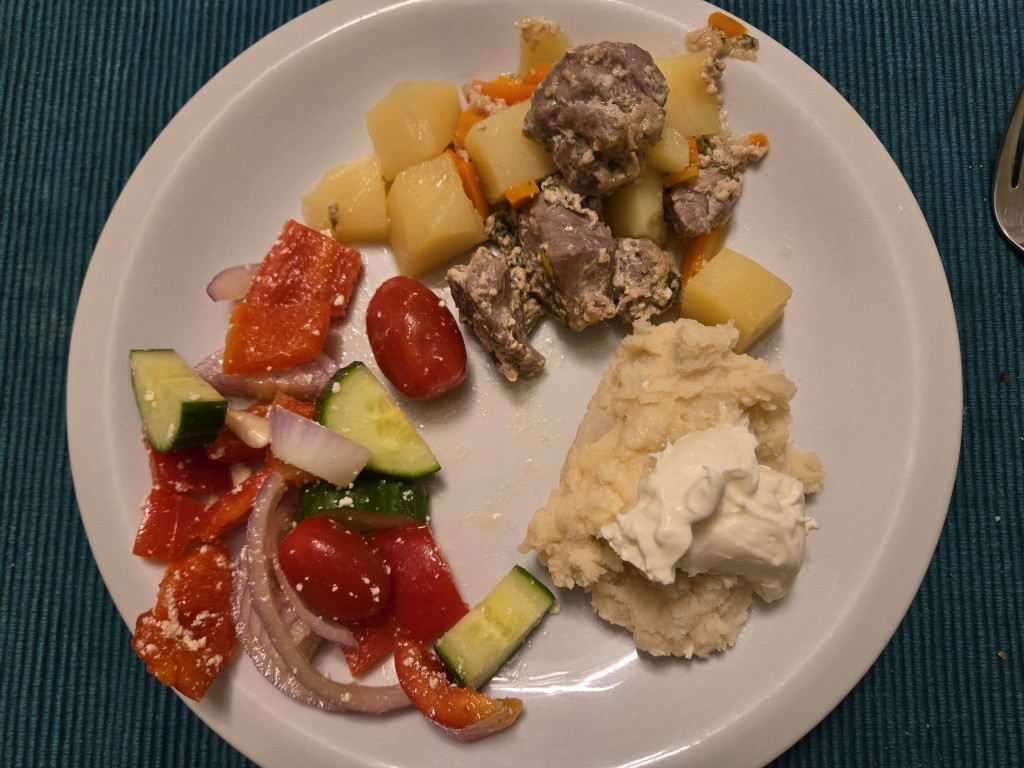
Let’s start with the Kačamak. It was edible. It was dough and potatoes and a little bit of cheese with heavy clotted cream on top. It needed a LOT more salt, ideally from a LOT more cheese.
Someday, we will do cornmeal porridge justice, but today was not that day.
Now let’s talk about the lamb. Oh goodness – all of the disappointment of the porridge was immediately forgotten, because the lamb was amazing. I had gone to a butcher and gotten excellent quality meat, and the potatoes had just absolutely devoured the flavor of the lamb and milk. There was just the right amount of salt in the dish, and I could have eaten three times as much.
And you know what? There’s a reason that chopped salad is a classic. It went perfectly with the lamb.
All in all, a nice meal, and good way to celebrate Canadian “gloss over our colonial past” day. (Not to be confused with American “gloss over our colonial past” day in November.)
Next up – Morocco!
Recipes:
Kačamak
Braised Lamb in Milk