International Meals – Mexico, Part 1: Oaxaca

By my count, this should be about our 110th country, give or take. I don’t have an exact count for a few reasons.  We didn’t start this blog until “Bosnia,” although at some point I will go back and transfer the old pictures off of Facebook. We also haven’t been consistent with our naming conventions – why “East Timor” but also “Côte d’Ivoire?”  Why “Korea, North?”

Just… shut up, OK?  That’s why.

Point being that we’ve done a LOT of meals at this point.  And a number of countries have had food cultures so diverse and extensive that we just couldn’t bring ourselves to do just one meal.  China got five.  India got four. Italy and Indonesia each got 3, and France got 2.  Again, no science to it, that’s just how we decided to do it.

But as we get into the second half of the alphabet, there’s not too many left that are screaming to be split up.  I’m pretty sure we aren’t going to get four meals out of St. Vincent and the Grenadines.  So with this meal we’re starting on what may be our last multi-meal country, Mexico.

And we’re using the same highly scientific process that we’ve used up to this point of “half-assing some research” to determine precisely which regions and meals will be represented.  We’re aware that what you get at “Mexican Restaurants” in the U.S. and Canada is largely “Tex-Mex” cuisine, which is a very specific (and delicious!) fusion of influences from Northern Mexico, but also Texas.

We’re going to try to stick with more specifically Mexican influences for these three meals, and the three regions we’re going to attempt to highlight are Oaxaca, Jalisco, and “vaguely north.”  Lots of planets have a North.

For Oaxaca, we’re going to make a single item. One sauce.

That’s right – we’re not even going to make the meat for this one.  Just buying a rotisserie chicken and pouring our sauce over it along with a side of rice and beans.  (Technically, we’re “making” the rice and beans, but that’s so little effort it doesn’t count.)

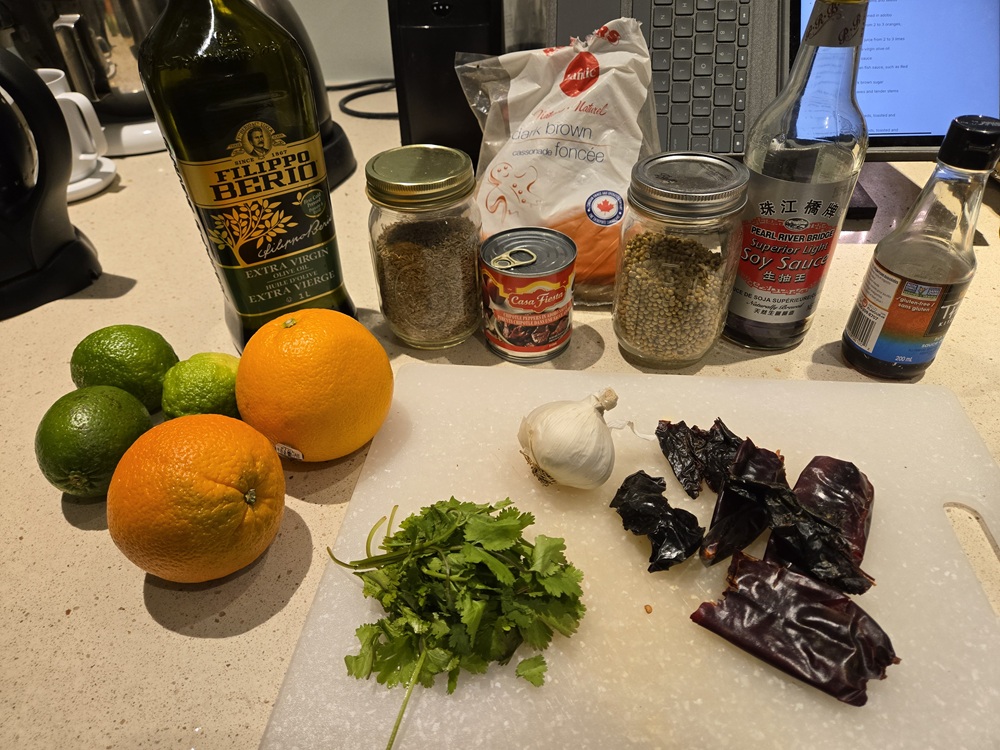
How can we justify this little effort?  Let me cut and paste the ingredient list for this single recipe, shall I?

  • 78 grams chilhuacle negro chiles
  • 38 grams pasilla chiles
  • 27 grams guajillo chiles
  • 1/2 ripe plantain
  • 2 Roma tomatoes
  • 2 medium tomatillos
  • 1/4 large white onion
  • 2 garlic cloves
  • 3 tablespoons lard
  • 2 tablespoons almonds
  • 1 tablespoon peanuts
  • 1 piece cinnamon
  • 2 whole cloves
  • 1 whole star anise
  • 1/2 teaspoon allspice berries
  • 1/2 teaspoon black peppercorns
  • 1 tablespoon pumpkin seeds
  • 1 tablespoon raisins
  • 1 tablespoon sesame seeds (plus more for serving)
  • 1/2 teaspoon cumin
  • 1/2 teaspoon thyme
  • 1/2 teaspoon oregano
  • 2 bay leaves
  • 2 corn tortillas
  • 5 cups chicken stock
  • 4 teaspoons kosher salt
  • 67 grams Mexican chocolate

That’s right – we’re making one of the most complicated sauces in all of global cuisine, black Mole.

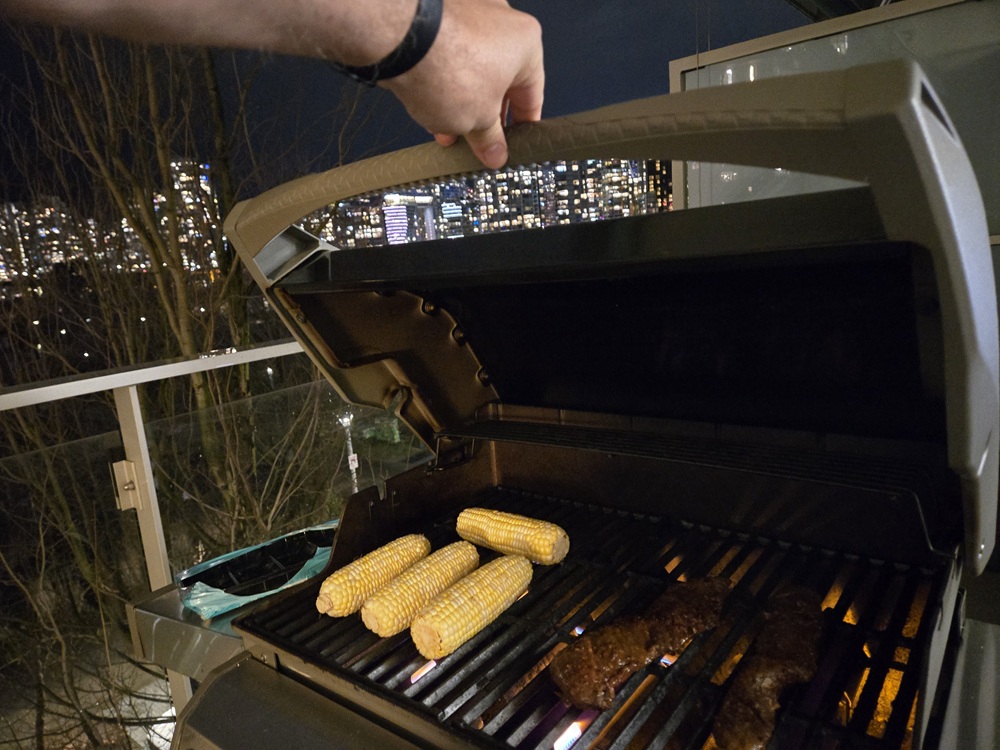
Step 1 – roast the chiles.  Wait – it’s the dead of winter!  How can we grill…

…oh wait, we live in Vancouver.

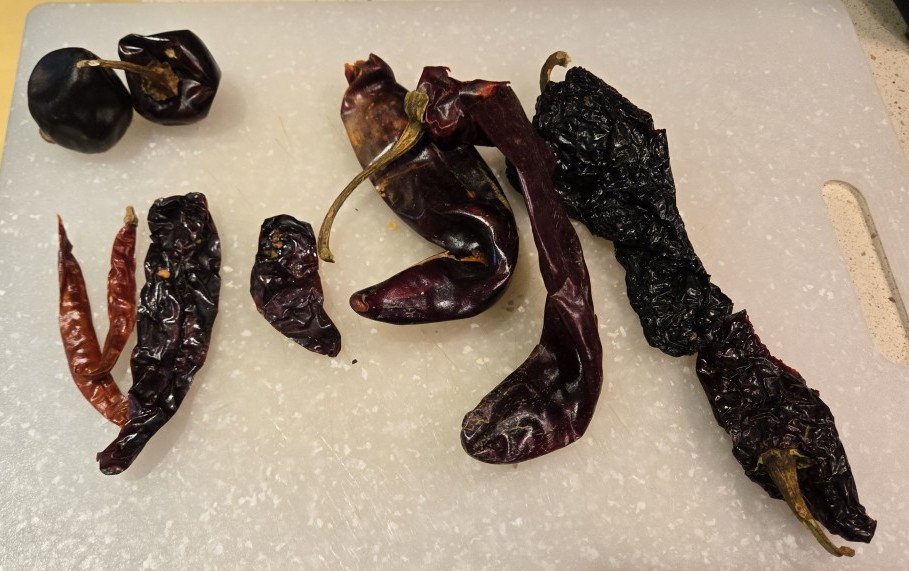
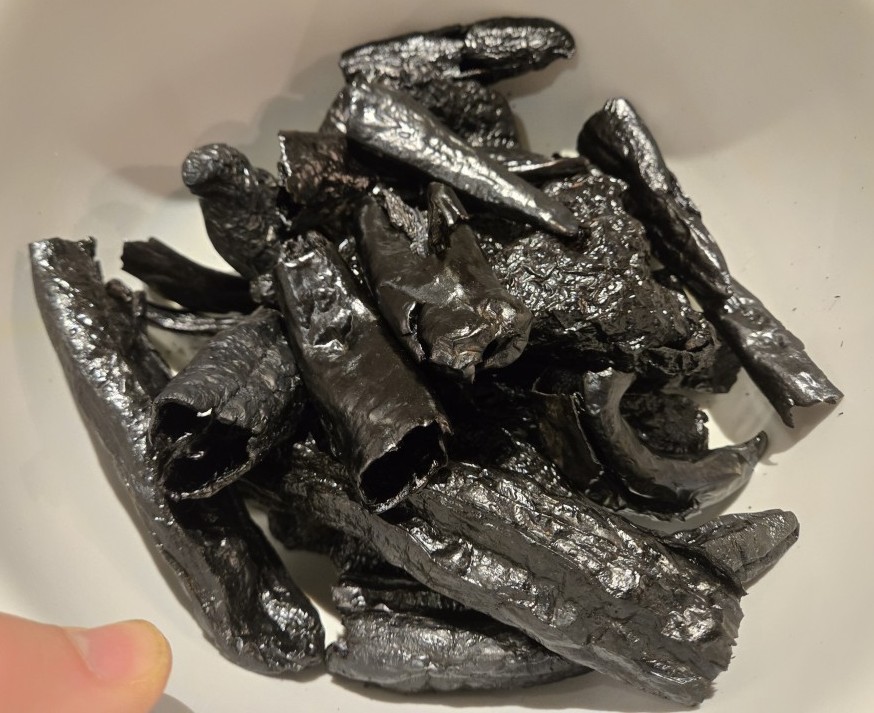
Honestly, this is still probably the  step we did the least well.  Martinez’s recipe (I had to look up how to properly punctuate that) stresses carbonizing the peppers on the grill and then washing and rehydrating them to remove the burnt flavor, but comments I’ve read since then disagree with this approach, and suggest it would have been better to pull them off a little sooner in the first place.

Before:

After:

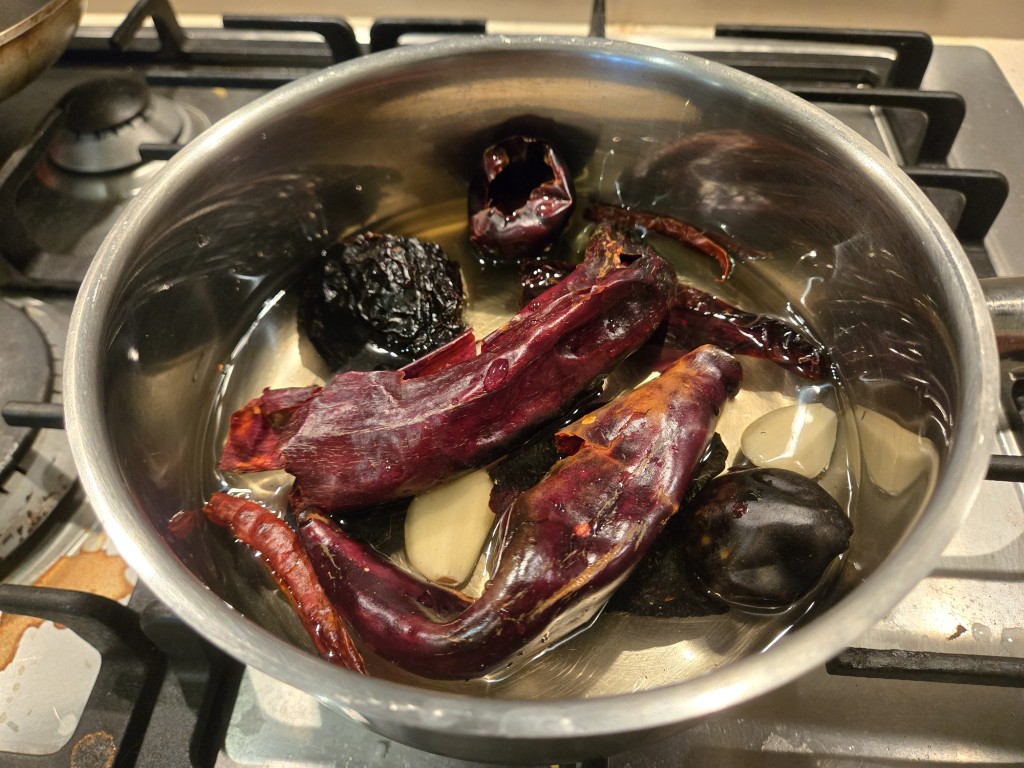
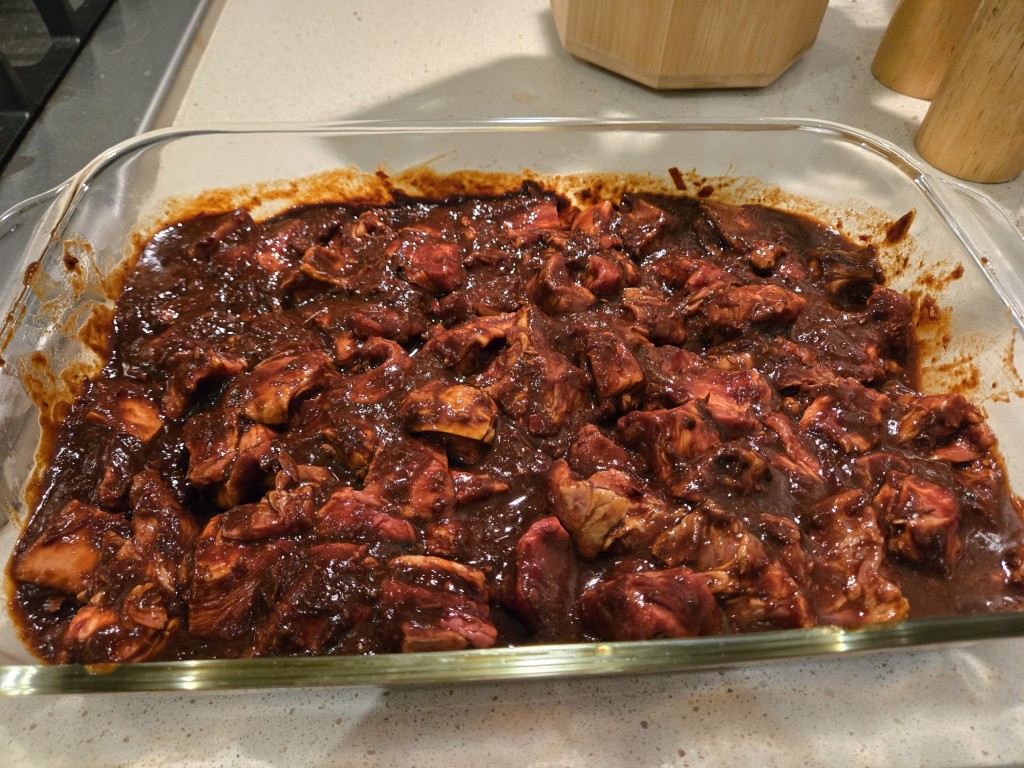
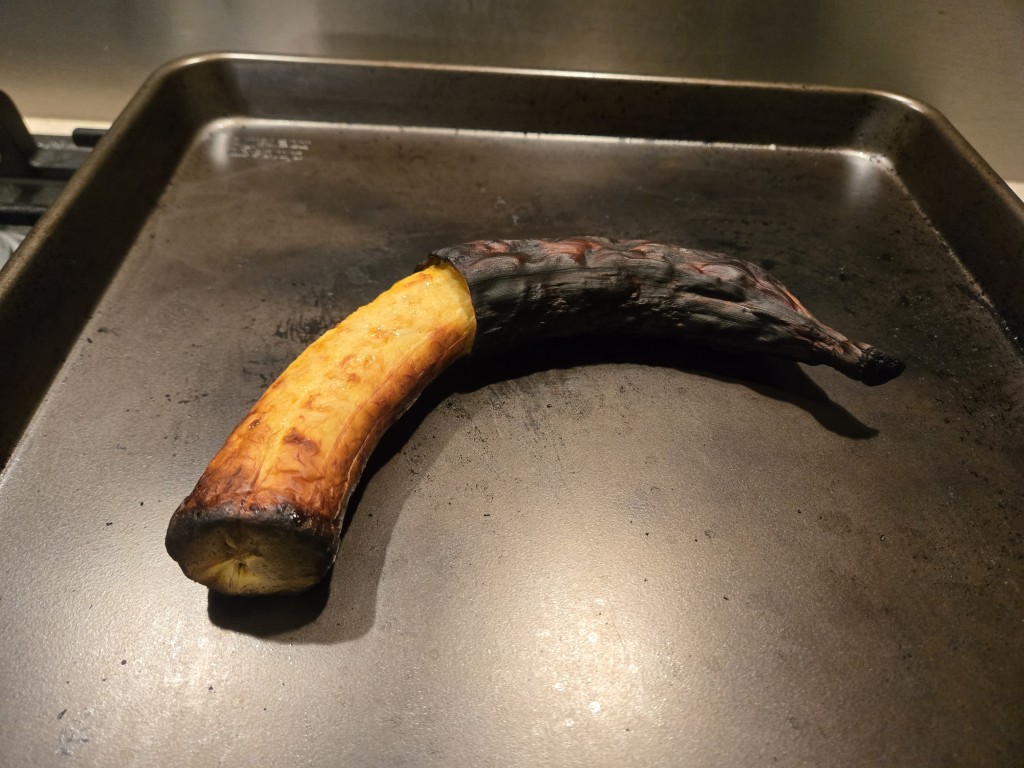
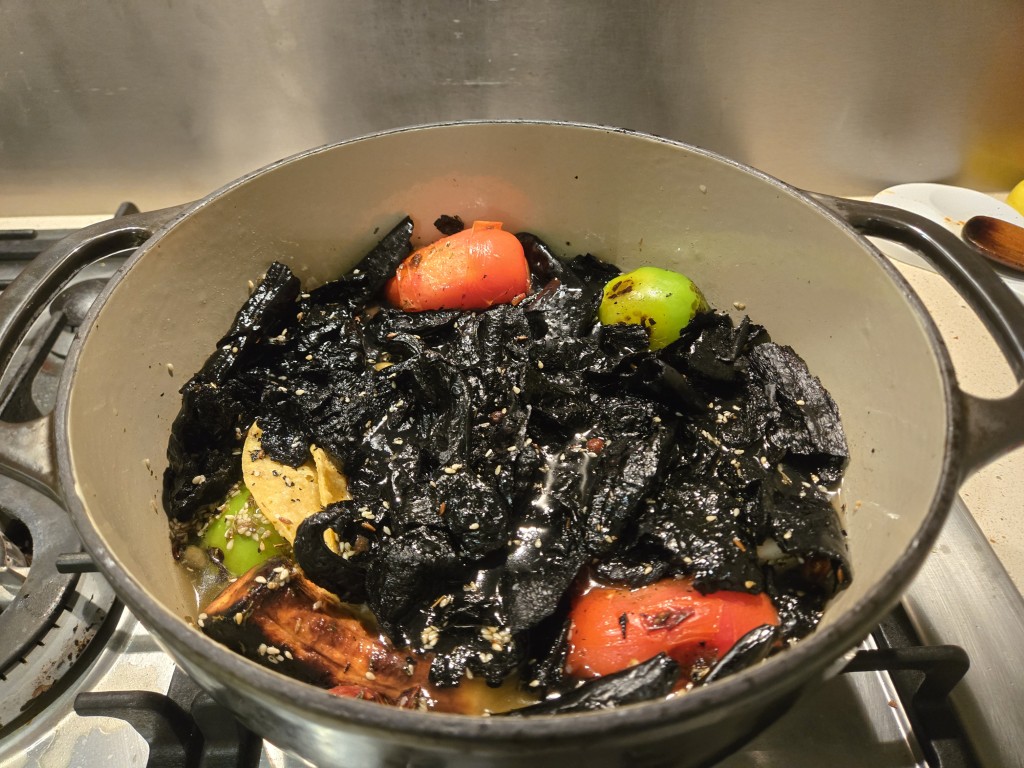
These were then washed and then left to soak in boiling water for an hour, which was intended to remove as many of the acrid notes as possible.  While the grill was still hot, we tossed on half a ripe plantain, which, hilariously, attempted to escape from its skin over the course of 20 minutes.


Note that the blackened skin on the left is empty – it contained the roasted plantain on the right when we started.

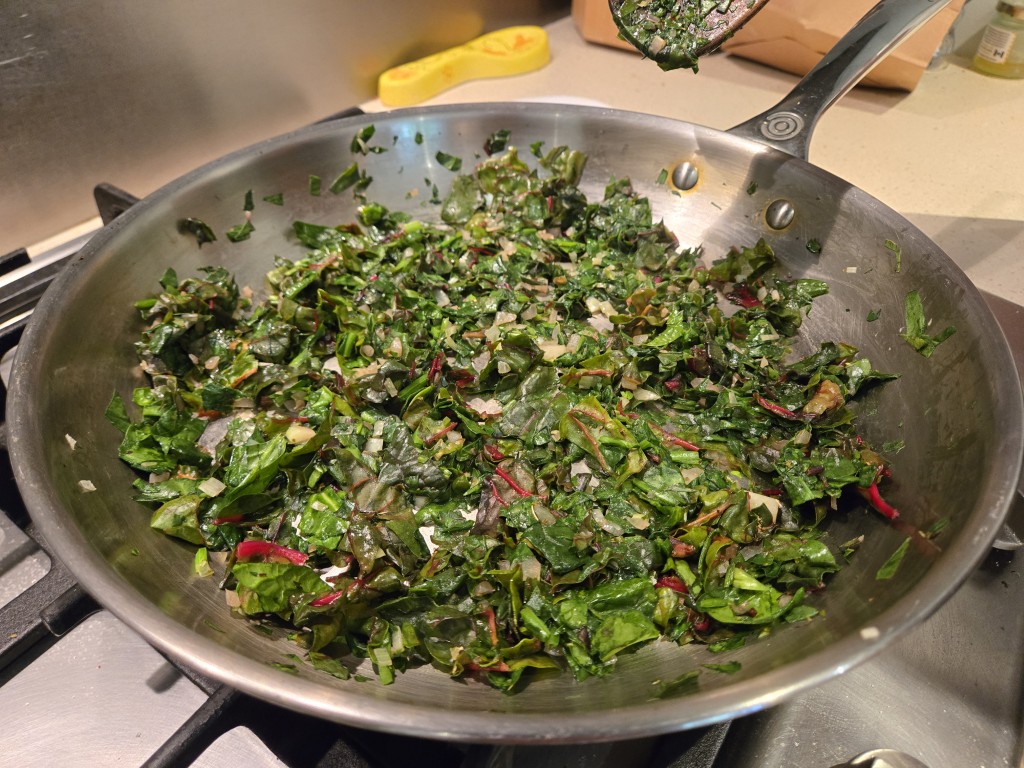
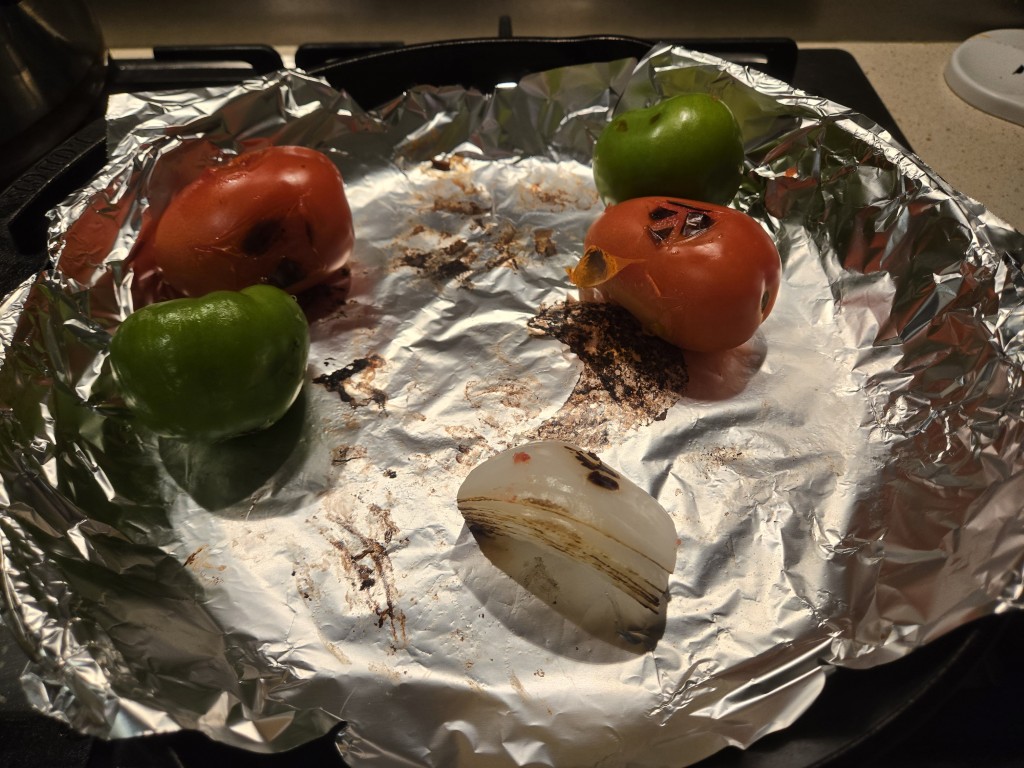
OK, what other prep do we need to do?  We need to blacken our veg.  I did this on a cast iron skillet, as instructed, but in future I might just haul out the blowtorch.


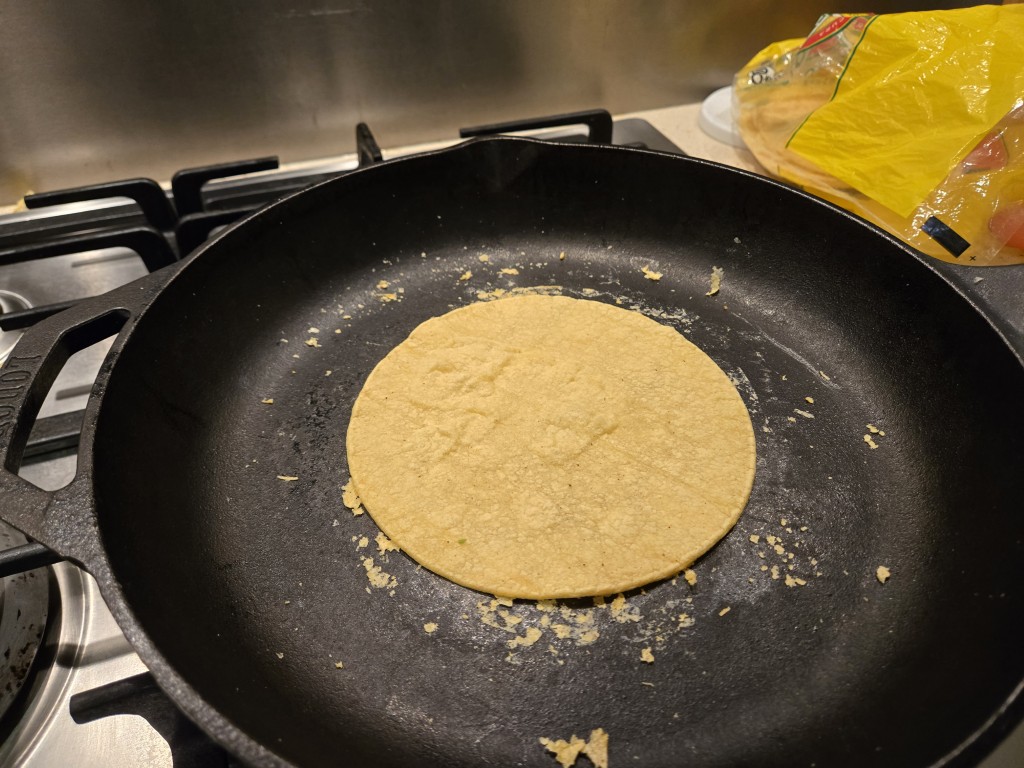
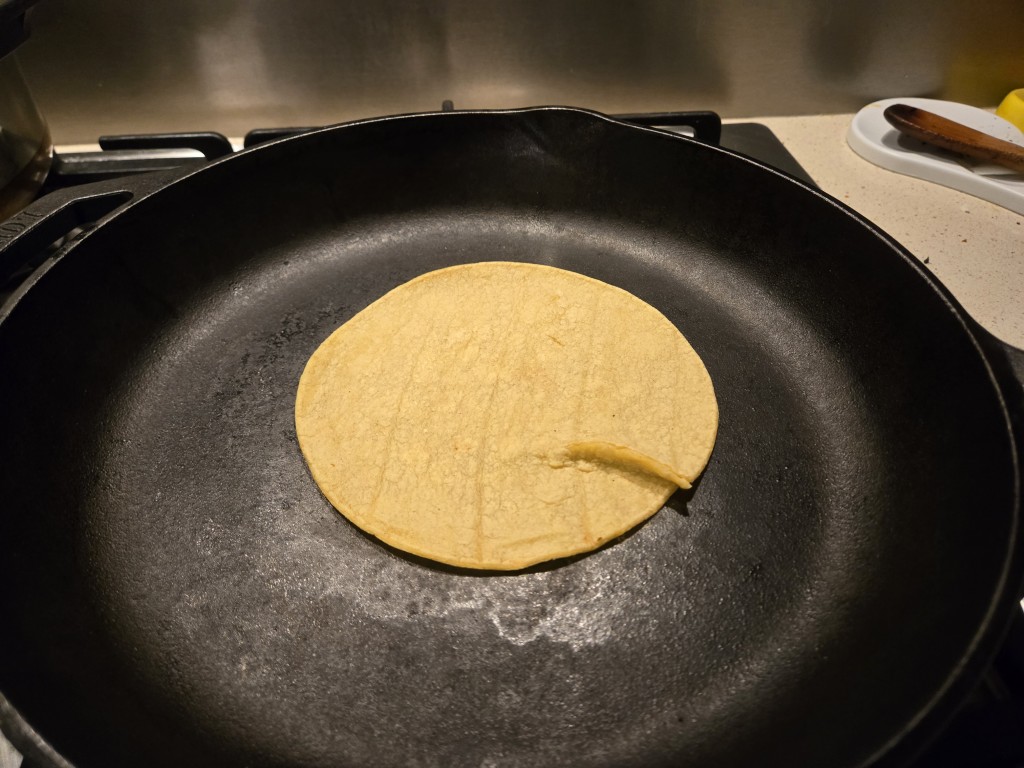
Need to toast a couple of corn tortillas, too.

The only other prep is to put all the ingredients in bowls so we can add them in the right sequence for the next steps.

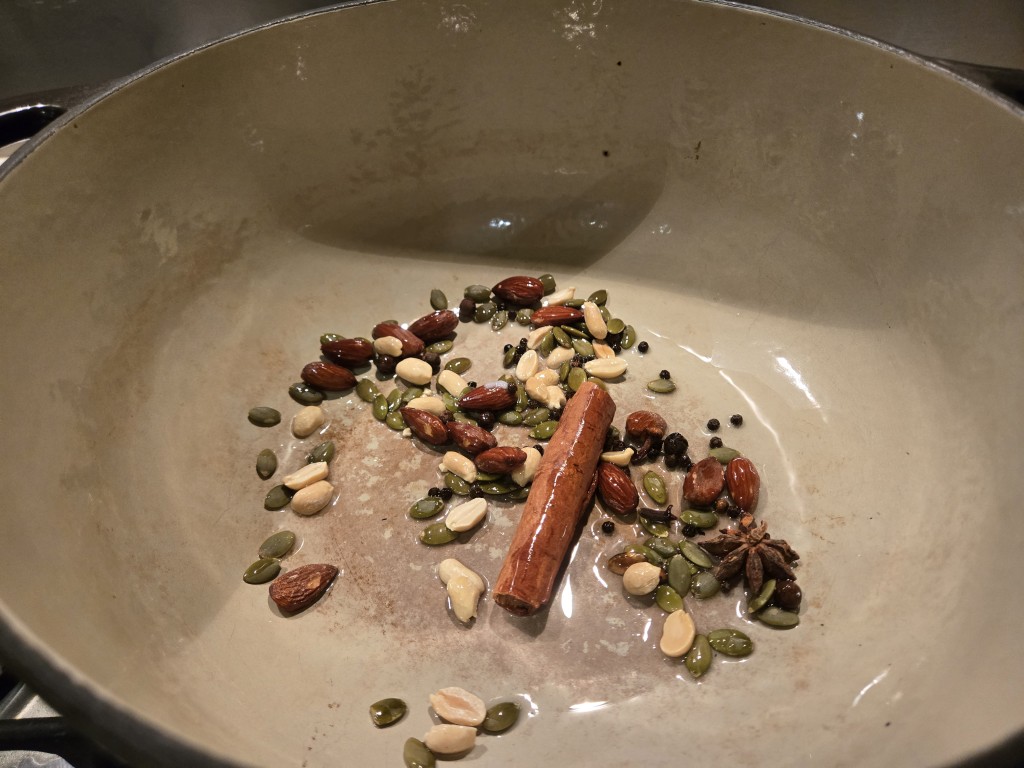
First up, melt the lard.  Then in with the almonds, peanuts, cinnamon, cloves, anise, allspice, peppercorns, and pumpkin seeds.

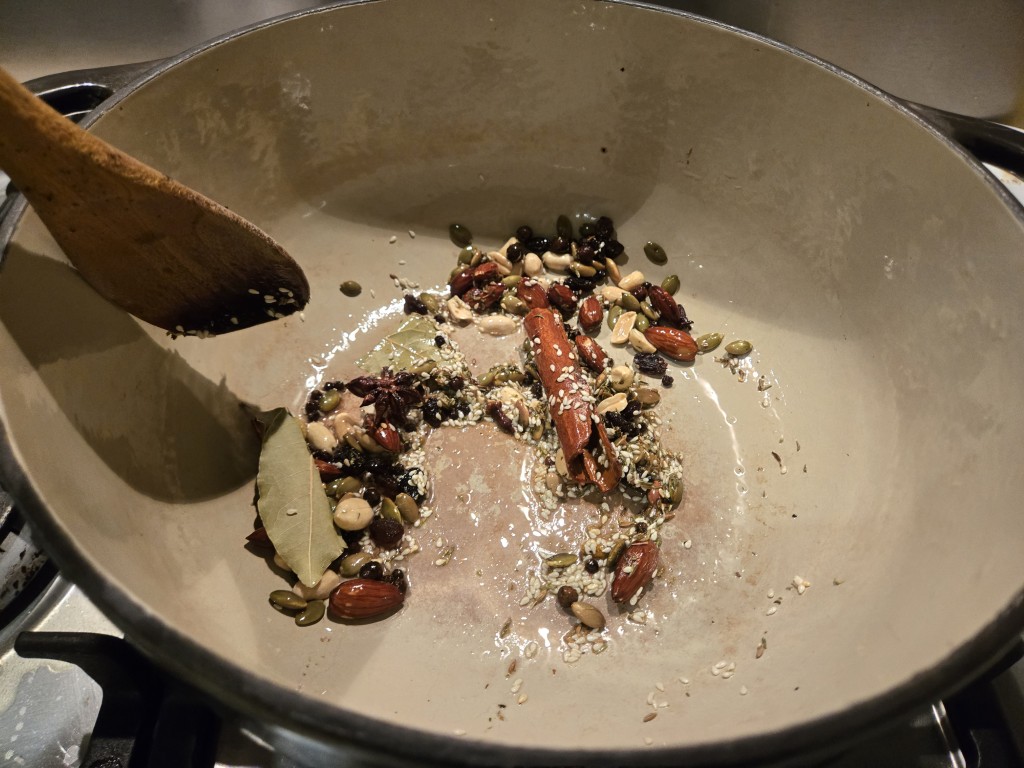
Next, raisins, sesame seeds, cumin, thyme, oregano, and bay leaves.

Once those have had a chance to toast a bit, in with almost everything else: chiles, plantain, veg, tortillas (yes, straight into the sauce), stock, and salt.

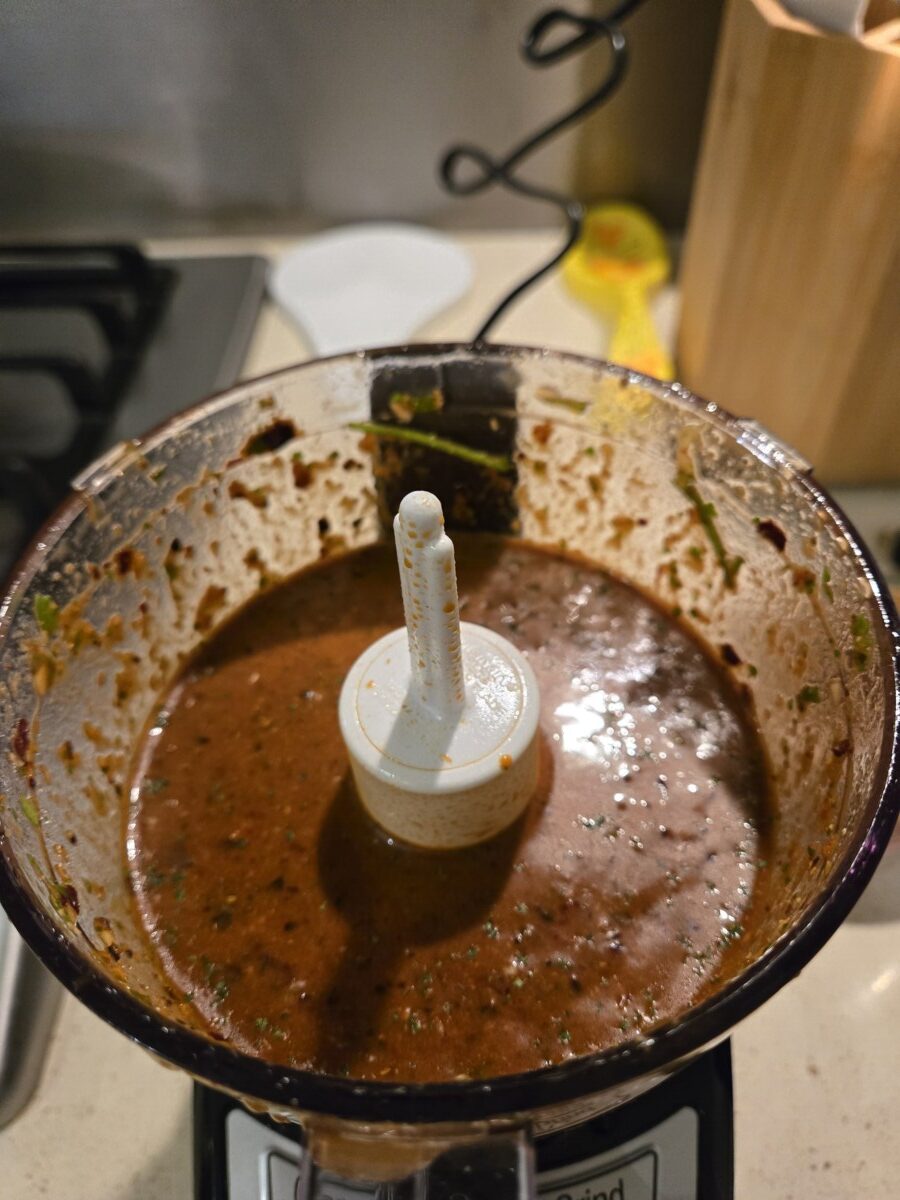
This gets simmered for an hour or so, then the whole mess goes into the food processor.

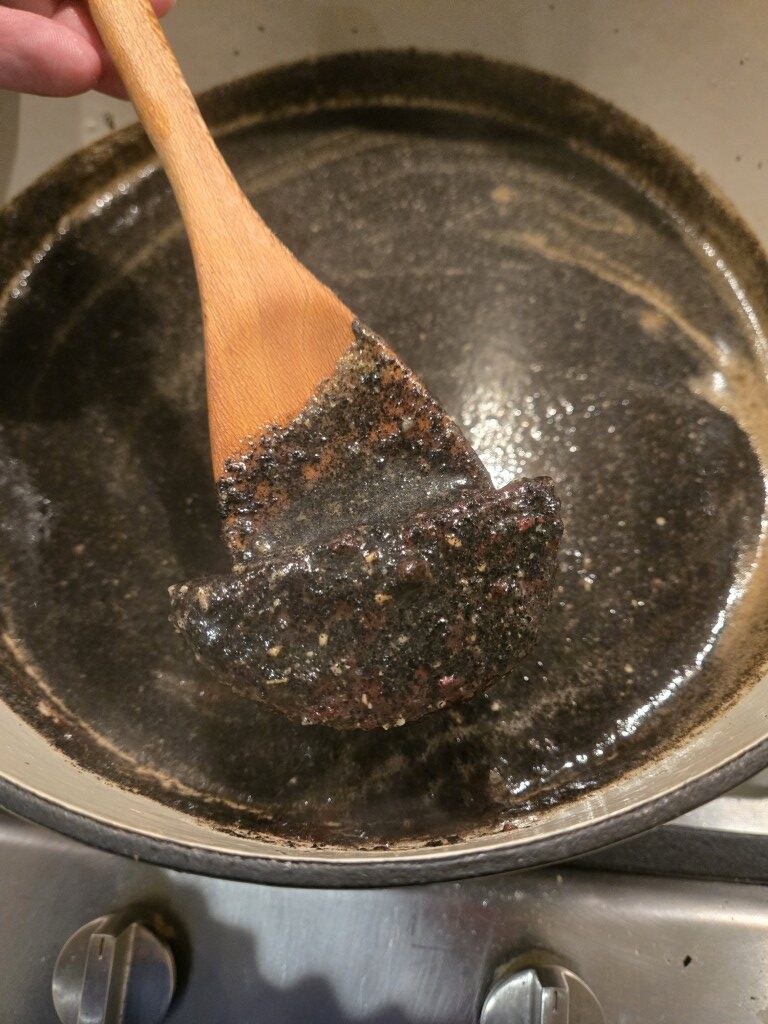
Once it’s all blended, you transfer it BACK to the pot with some more lard and then cook it for another ten minutes. When it’s finished, you turn off the heat and then stir in the chocolate.

And that’s it!  A bit gritty, since we weren’t using an honest to god blender, but the color is beautiful.

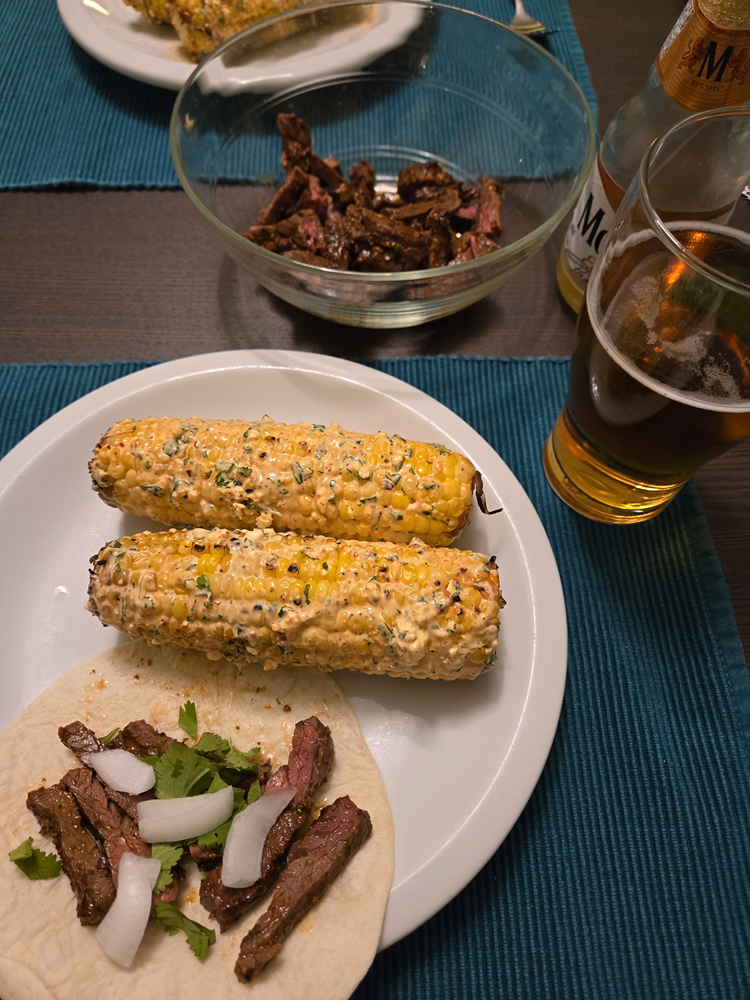
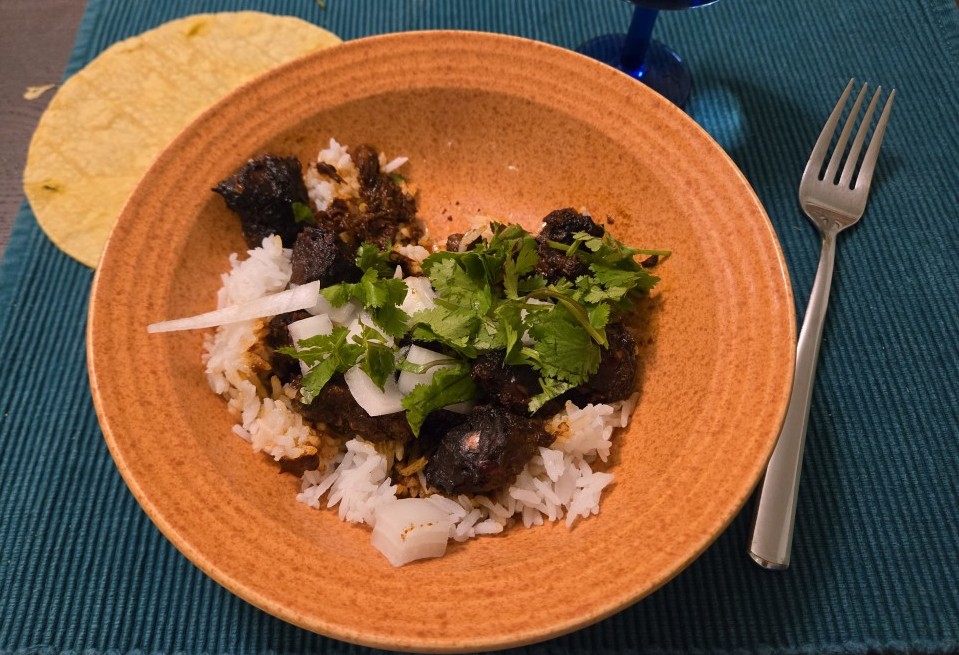
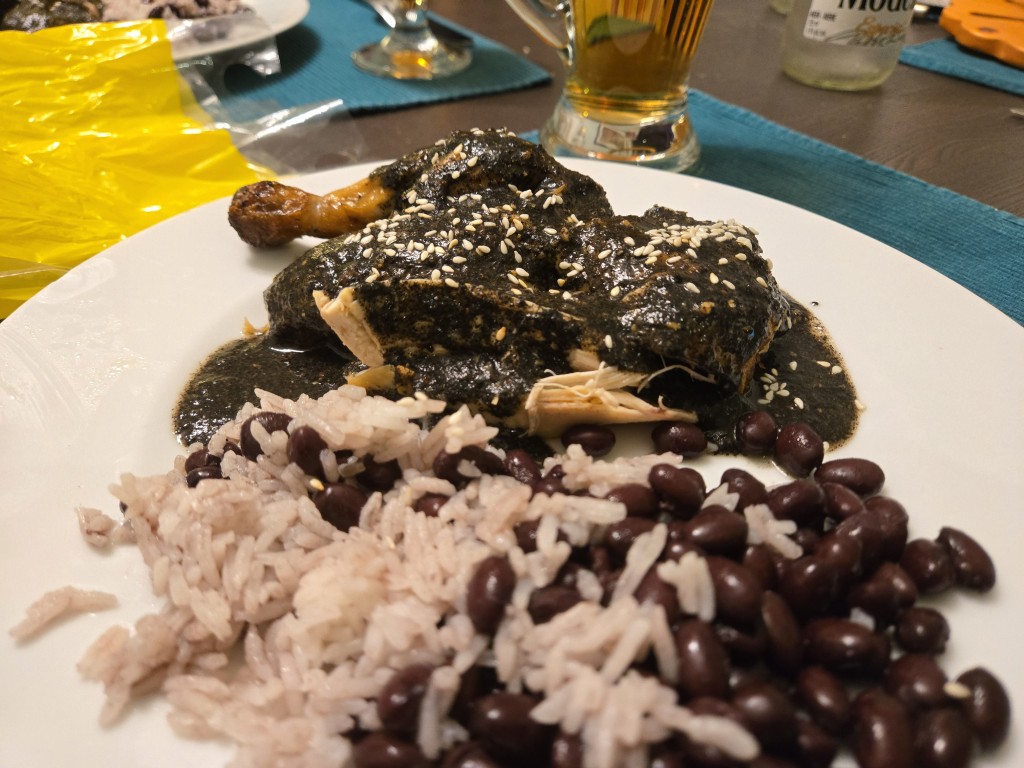
None of the recipes for this dish pay the slightest attention to the chicken.  “Serve over chicken” is how it’s usually described.  So given that, we just got a rotisserie chicken from the neighborhood grocery store.  A little rice and beans, a bag of corn tortillas, some Mexican beer, and here’s the final spread:

Pretty, innit?

In terms of flavor, it’s obvious what the GOAL was.  You could definitely taste the rich complexity of the sauce.  But… I think we did burn the chiles a bit too much.  I see the approach this recipe was going for, but I think I would have preferred having a bit less burned flavor to try to wash back out.  Still – this sauce is a BEAR, and I’m proud of us for even attempting it.

Next up, Jalisco! Home of tequila!

And probably also food, we’ll have to look into that.

Recipe:
https://cooking.nytimes.com/recipes/1023509-mole-negro

International Meals – Mauritius

When I was in grad school…

No not for the Physics degree, before that.

No not the previous one either, the one before THAT.

Dear lord, I’ve spent way too much time in college.

At any rate, ONE of the times I was in grad school, I had a fellow member of my cohort who was from Mauritius.  She said that she used to have trouble at immigration control, because the country was so tiny that it sometimes didn’t appear on their list.

“I’m from Mauritius.”

“Mauritania?”

“No, Mauritius?”

“You’re from Mauritania?”

…sigh “Yes, I’m from Mauritania.”

“C’mon in!”

This was obviously a different time.

Speaking of different times, at different times, Mauritius was occupied by the Dutch, the French, the British, and was visited by the Arabs and Portuguese.  There’s no evidence Zheng He ever went there, but sure, why not – let’s say he did too.

Suffice it to say, the food culture of this island is quite diverse.  In terms of the national dish, the one that comes up the most often as a candidate is a lentil filled flatbread called dhol puri. And since flatbread by itself is kinda boring, we’re going to make another dish called sausage rougaille.  Rougaille is a tomato based sauce that is quite common on Mauritius, and putting sausage in it is a good way to get some protein in there.

I found a website which appears to be written by an expat, so we’ll go with her recipes.

First, the flatbread.  You take channa dal (split yellow lentils) and boil them.  How long?

“Until mushy”.

Oh dear – it’s THAT kind of recipe is it?  Ugh. Fine. How about an hour?  That seemed to work.

Once the peas are properly mushy, you blend them with some tumeric, salt, and cumin seeds to make a paste.

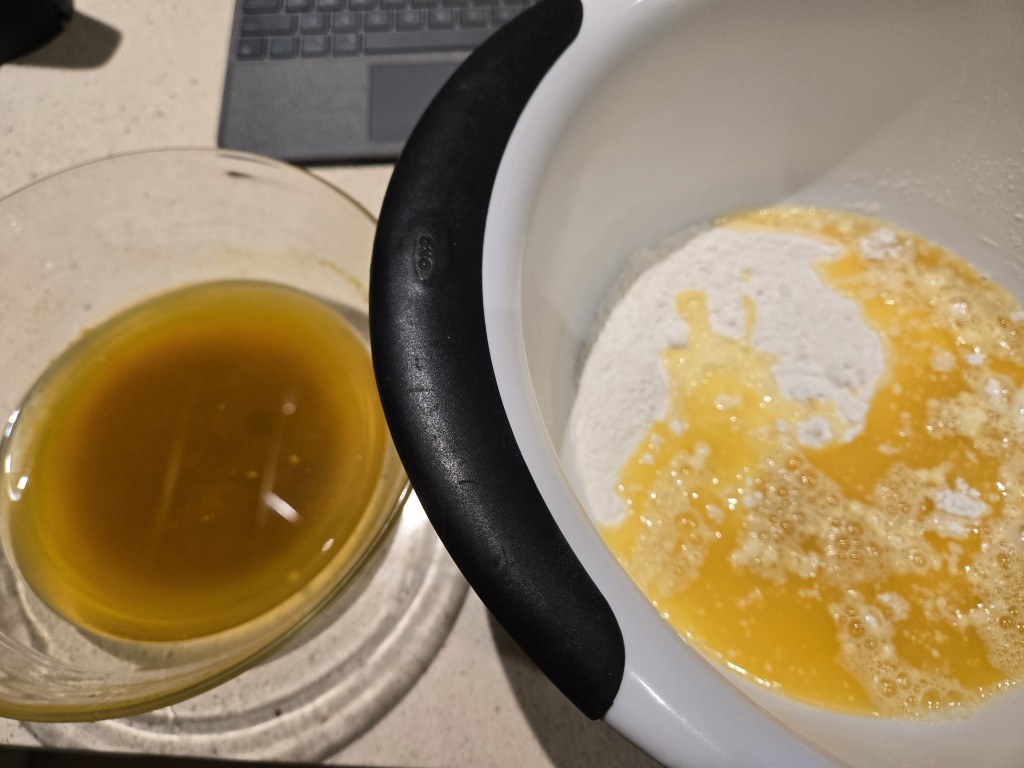
You also make a basic flour and water dough and leave that to rest a bit. But the interesting thing there is that you use the bean water to mix with the flour.


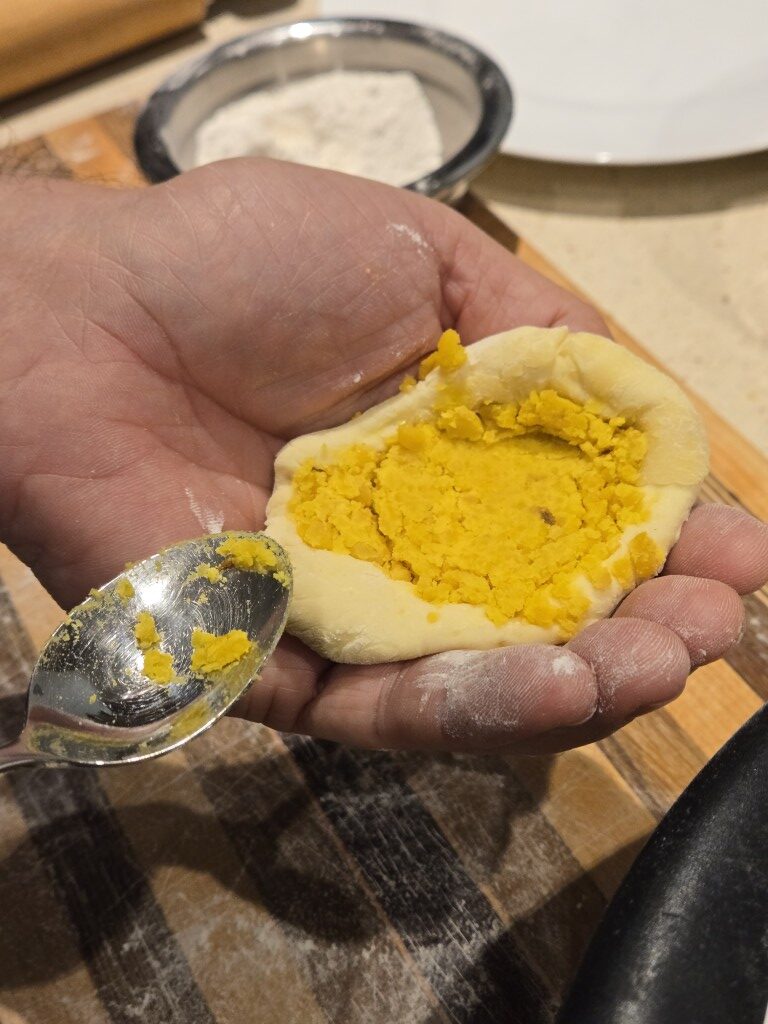
Once the dough’s had a chance to rest, you fill it with the chick pea mixture.

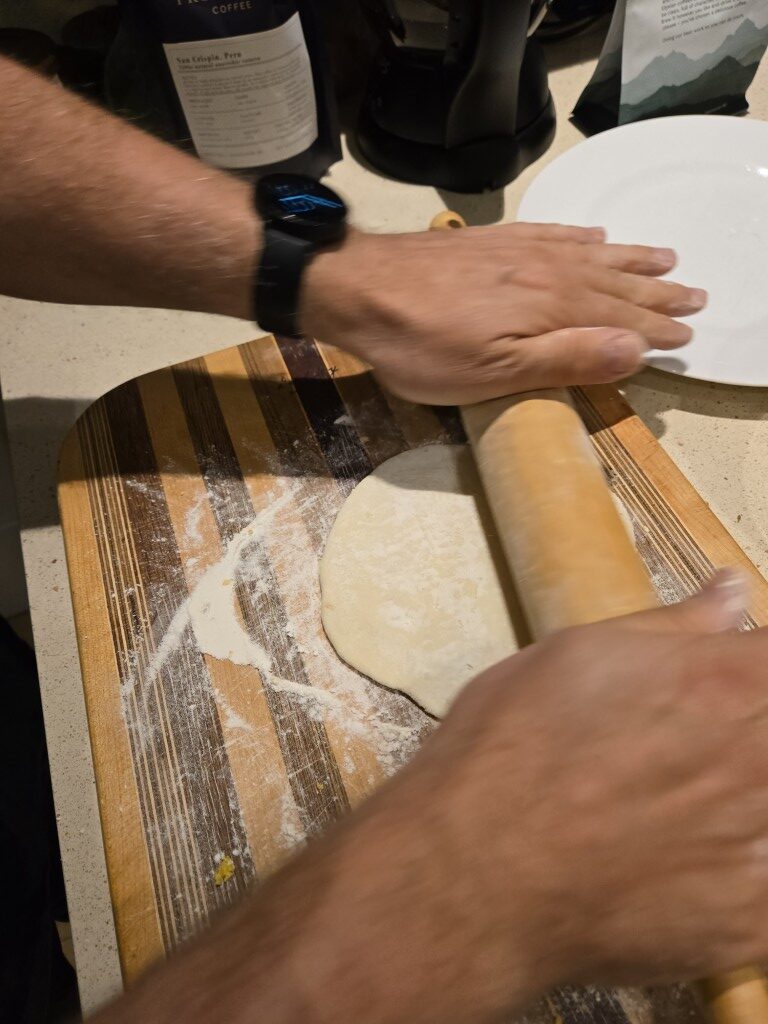
That gets sealed into balls, and those are rolled super thin for cooking.


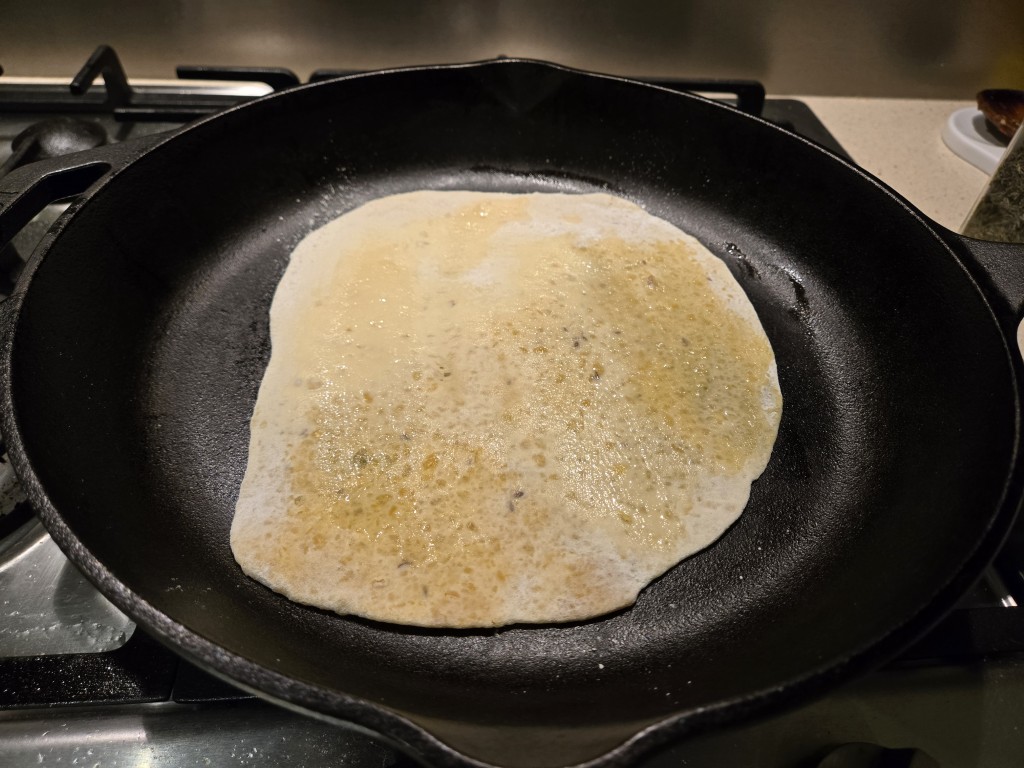
Cooking couldn’t be simpler – just grill on both sides for a few minutes each.  One thing the video I watched stressed, however, is that every time you flip one of these things over, you should brush it with a little oil.  I suspect a lot of the flatbreads we made for our Indian meal would have gone better if I had heeded this instruction – it really did make a difference in keeping them soft.

OK, what shall we eat WITH these breads?  Rougaille turns out to be fairly straightforward.  First you sweat some onions with thyme, coriander seed, curry leaves, ginger and garlic pastes, and… peppercones?

You know what, my French isn’t any better.


This actually smelled pretty amazing all by itself.

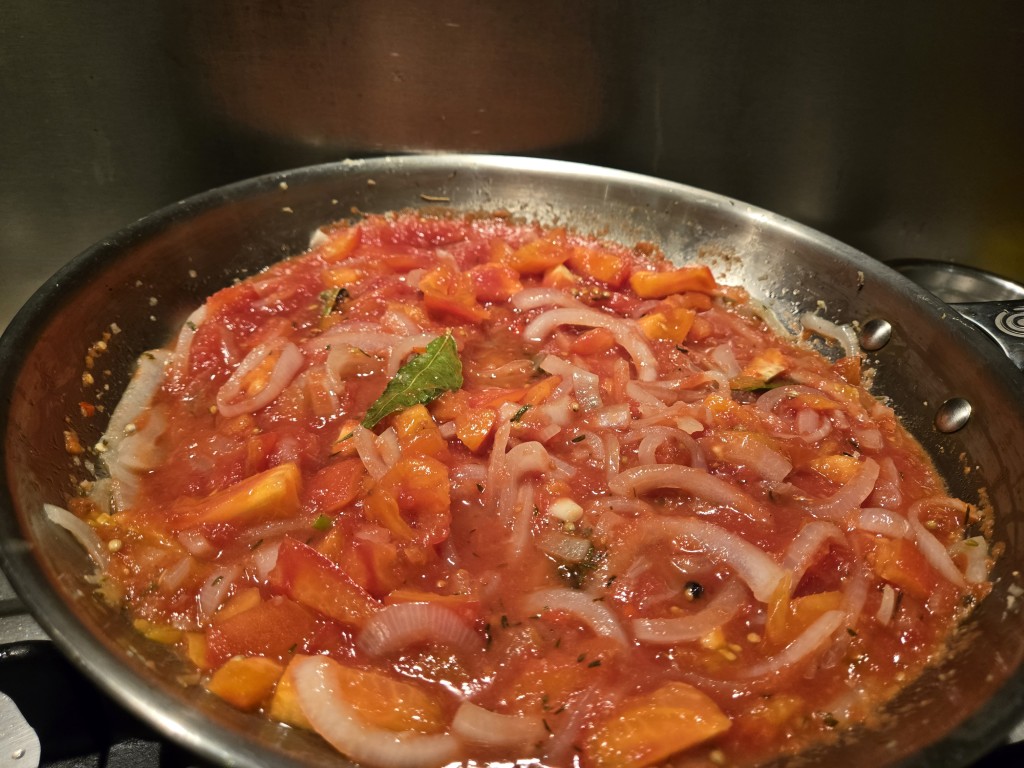
To this, you add tomato puree and diced tomatoes.  The recipe actually called for a specific brand of tomato puree, but we definitely don’t have that one at our local Save On.  So I just pureed a can of basic “diced, no extra salt.”

And in it all went to simmer down.

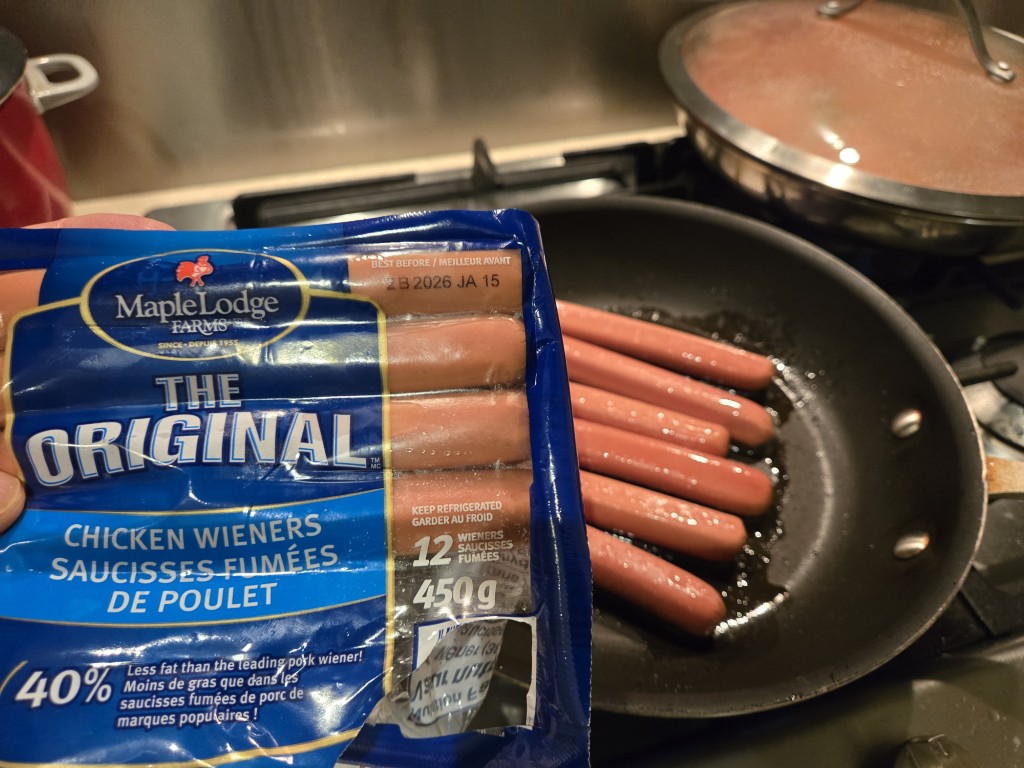
Speaking of specific brands, I DEFINITELY didn’t have the specific brand of honey chicken sausages the author was asking for, so I just got some bog standard mechanically separated chicken wieners.

I shouldn’t be so dismissive – these things smelled pretty good while they were being browned.  A little color imparted, they were chopped into short segments and chucked into the tomato sauce to finish cooking, and that was the dish!

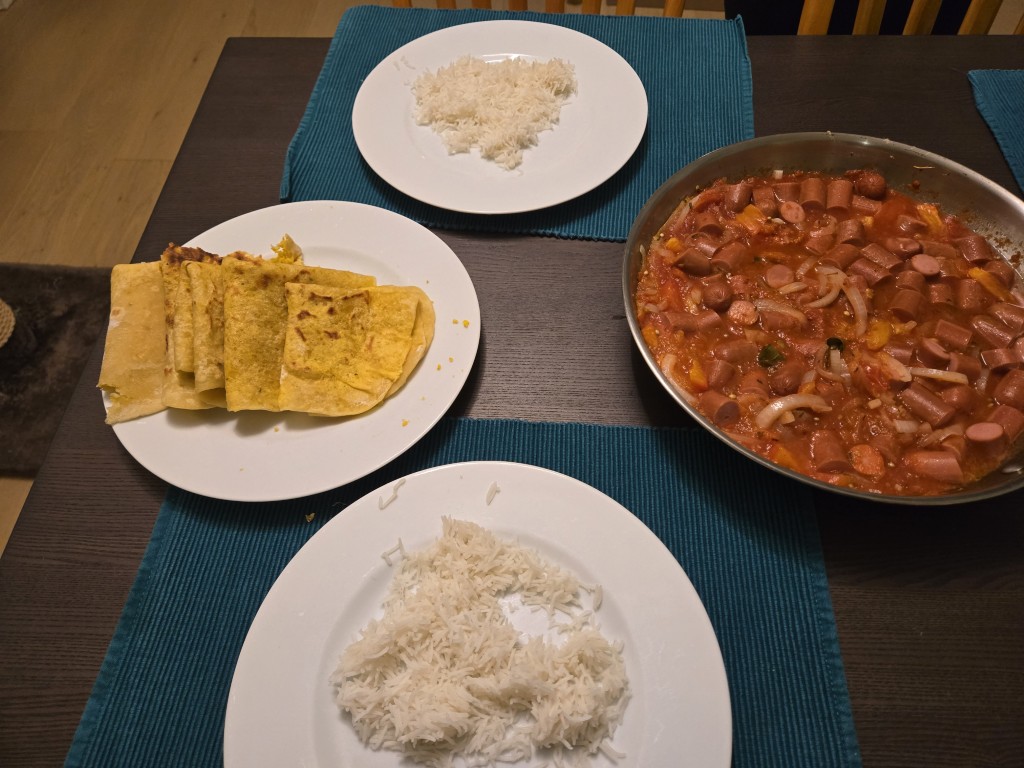
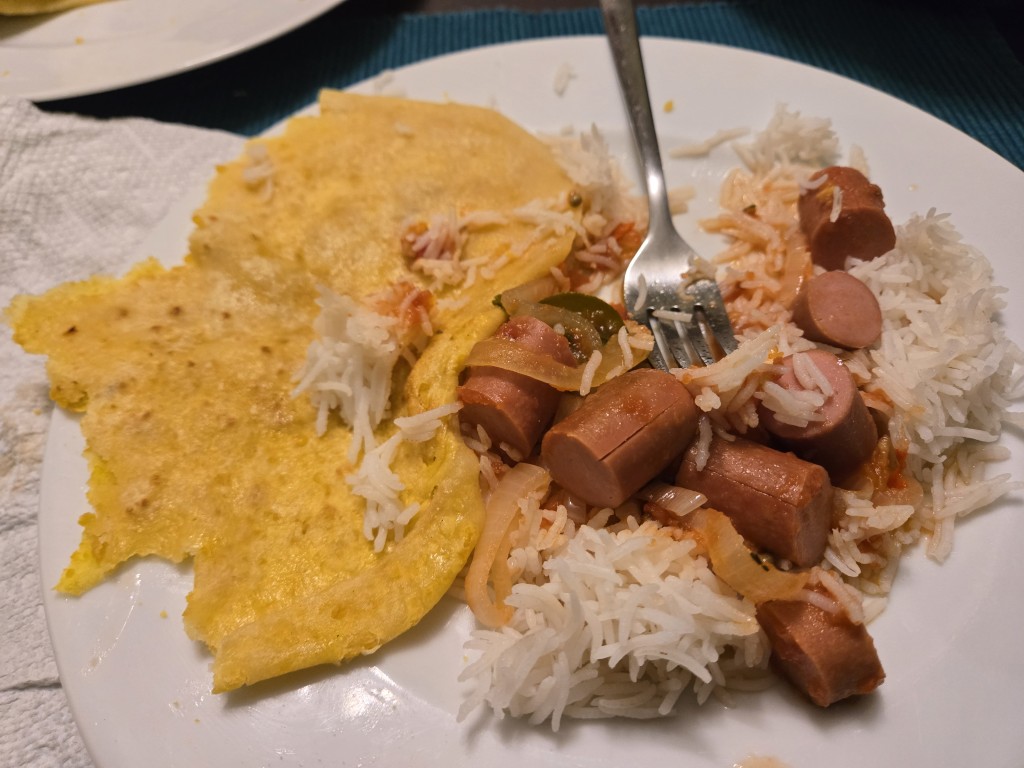
Here’s the whole meal, with some white rice to fill it out.

This is one of those things where showing everything separate isn’t really an honest picture of what the meal is like.  Here’s a better idea:

That looks more like a nice tasty home cooked meal.  And it was!

The tomato sauce, in particular, was REALY good, from all the seasoning.  The chicken wieners punched surprisingly above their weight, and the bread had a great texture for scooping it all up.  In terms of flavor, the bread was a bit dull, but it’s nothing a bit more salt wouldn’t have probably fixed.

Mauritania, I’m sorry, Mauritius, really has some tasty food – we’d certainly be down to try some more at some point.

Next time, the start of what we suspect is the final country we’ll be breaking into multiple meals!

Recipes:
Sausage Rougaille
Dholl Puri

International Meals – Mauritania

Mauritania is a west African country bordered to the south by Senegal and to the north by…

(checks notes)

You know what, never mind.

It is presently in a period of democrac-ish, which is good, but still has an uncomfortable amount of slavery, which is very, very bad..

Let’s just get to the food, shall we?

We struggled to find a dish that wasn’t more identified with either Morocco or Senegal, and we eventually settled on Leksour, which is a lamb stew served over millet flour pancakes.

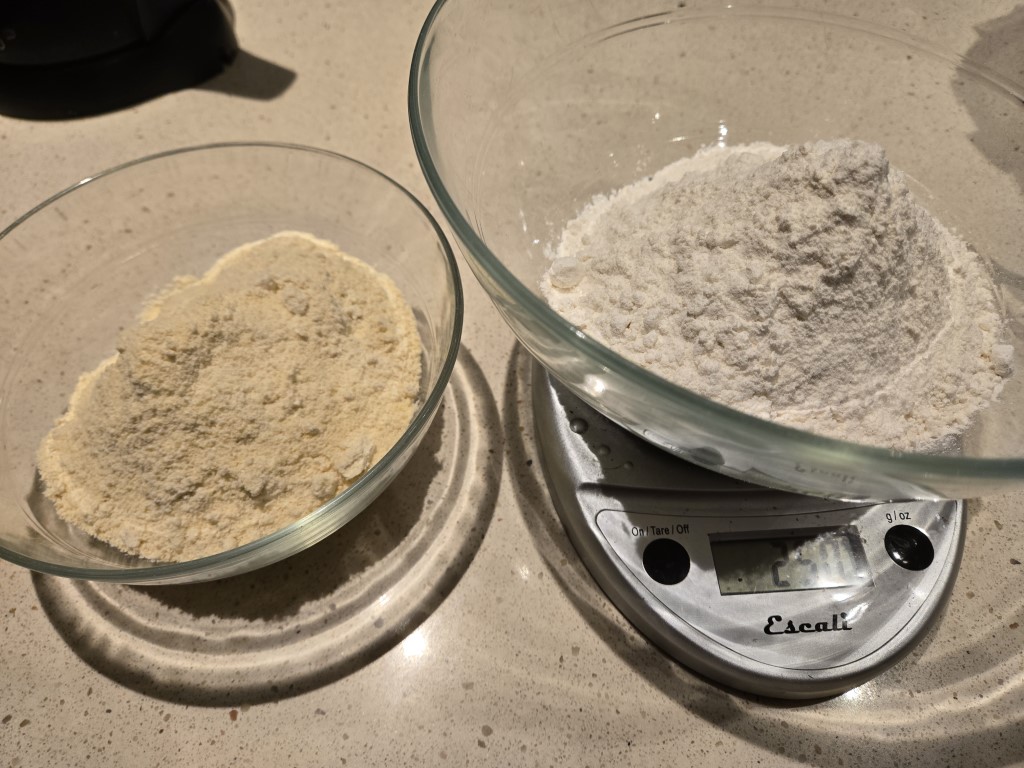
Rather than buy millet flour, I used our spice grinder to make it from some millet we had left over from a previous recipe.  (I’m NOT going to back and try to identify which one, because then I’ll have to admit how long that millet has been in the cupboard.)

Millet and wheat flours

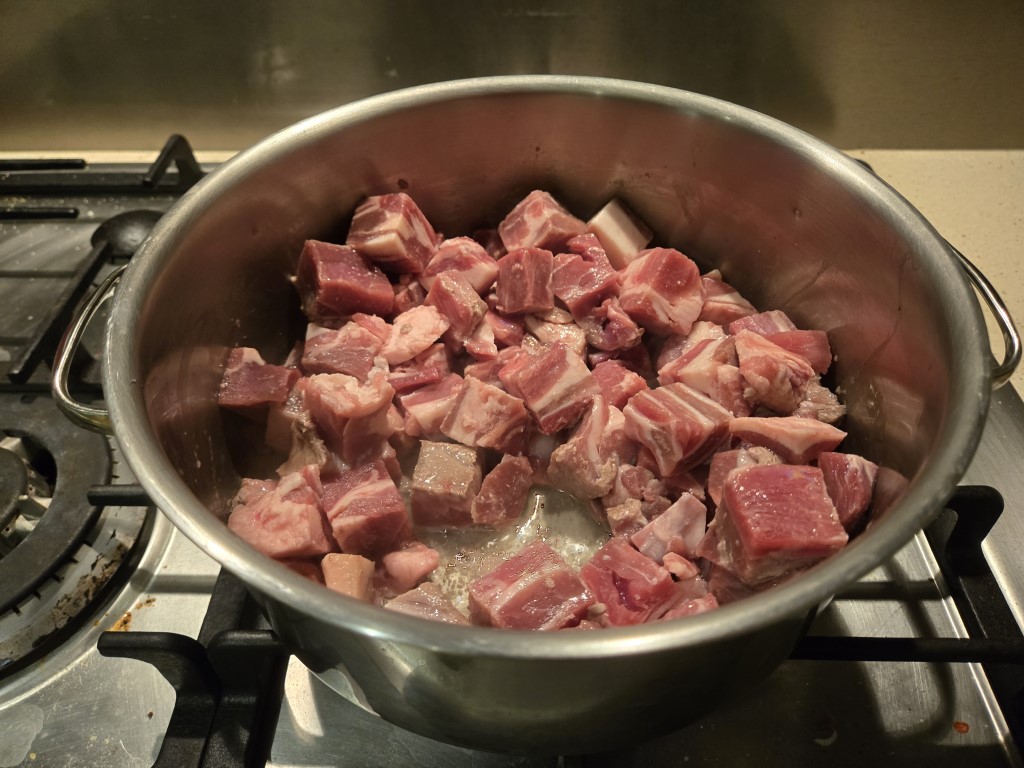
The flours are mixed together with water and a bit of salt, and that batter rests for a bit as you get to work on the stew.  Which, to be fair, is pretty straightforward.  Brown some stewing lamb.

Lamb chunks

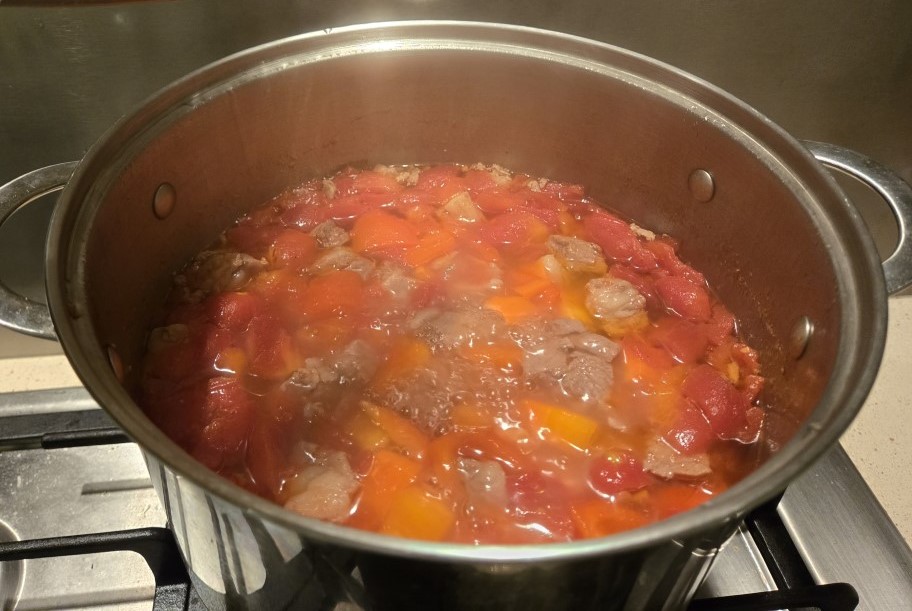
Chop up some vegetables and toss them in with salt, pepper and a bay leaf.

Lamb stew cooking

Then stew for an hour.

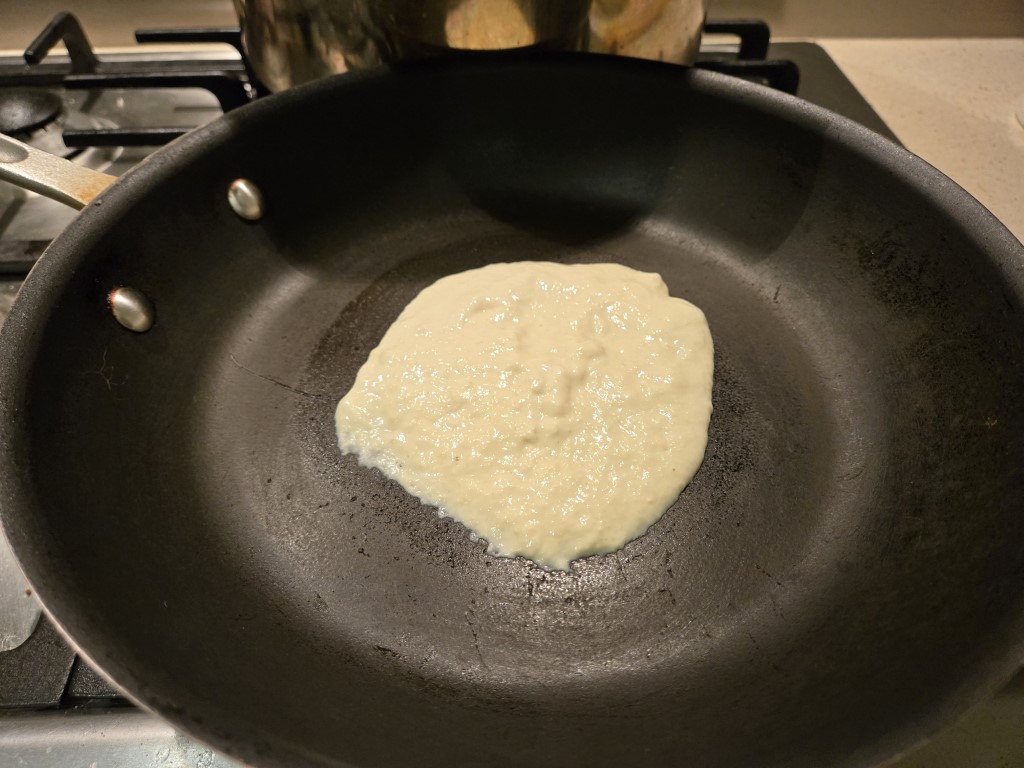
The pancakes were interesting – the dough was substantially stiffer than normal pancake batter, but given that the ratios for flour to water I found online were all over the map, I’m not sure if it was supposed to be or not.  None of them seemed to either burn, or be too undercooked, at any rate.  I think they may have been a little under, but it’s hard to say – there’s also a variety of colors of the millet itself out there to choose from.

Millet pancake cooking

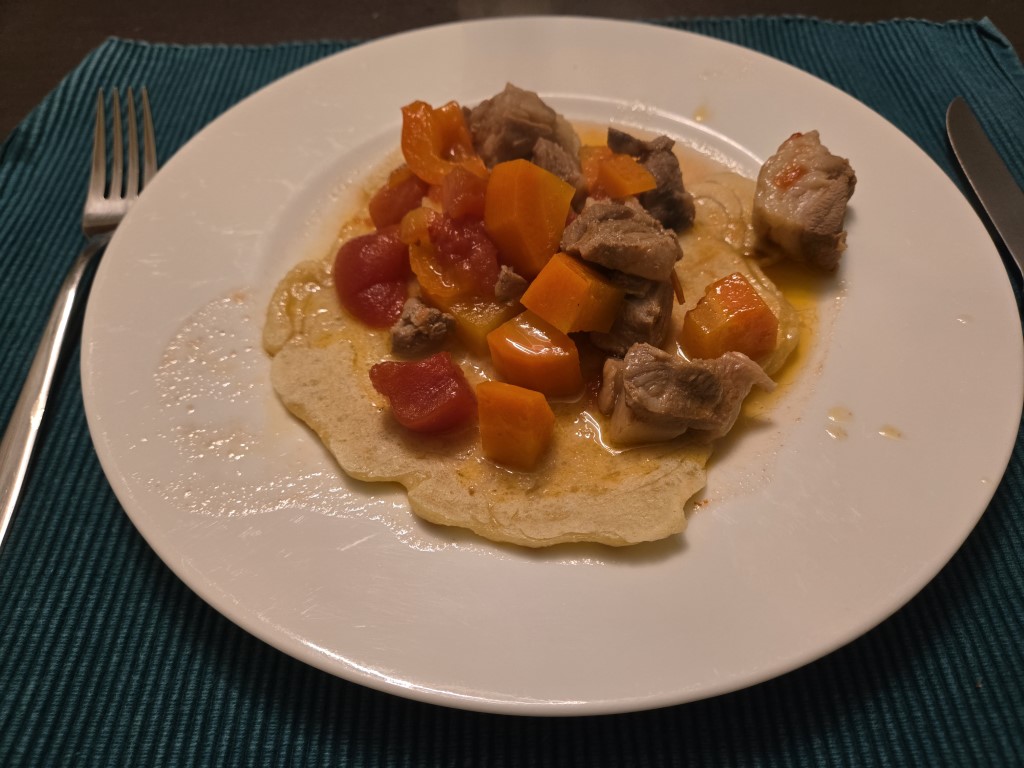
And once the pancakes are ready, you just put the stew on the pancakes and eat it.

Mauritanian stew

And it was fine.  There’s nothing wrong with a basic lamb stew, and the flatbread was good to soak up the juices.  But it was also… pretty basic.  The research for African countries is frequently difficult, as we’ve discussed earlier, and I’m sure there’s more interesting things that could be done with this if we had a better sense of what the normal range was.

But as it was, we had a nice Thursday night dinner and leftovers for several days.

Next up, we’re off to a country whose name could easily be mistaken for Mauritania, but isn’t.

Recipe:
Leksour (Mauritanian-style Pancakes with Sauce)
 

International Meals – The Marshall Islands

After doing the Maldives a few meals ago, we’re back out in the ocean for a country with an even higher ratio of water to land – the Marshall Islands. This time it’s not the Indian Ocean – we’re going to be a bit more Pacific than that.

Sorry.  However, if I’m going to say anything much about the history of the Marshall Islands, that’s the last bit of levity we’re getting for a while.  You see, the most famous of these Islands is Bikini Atoll, where the good ‘ol USA decided to set off the first hydrogen bomb.  And then the second one.

In time, the US would detonate 67 nuclear weapons in the Marshall Islands at Bikini and Enewetak atolls. The health impacts of the tests are still felt today, and likely will continue to be a serious issue right up until the likely destruction of the entire country due to climate change.

Woof.

OK, let’s talk about some food now, please?

The Marshall Islands have at various times been inhabited and / or governed by aboriginal populations from Australia and elsewhere, Germany, Japan, and the United States.  They’ve been independent since 1979, although they still depend on the US for things like (checks notes) bank insurance?  Huh.

At any rate, that’s a lot of influences.  As one might expect, fish is quite common, and as we’ve seen in other oceanic countries, pumpkin also comes up a lot.  Although rice isn’t native to the islands, a glutinous rice ball is a very common side dish, and finally the arguable national dish is a macadamia nut pie, despite the fact that macadamia nuts AREN’T originally native to these atolls.

We’ll get to the pie, but let’s make our main dishes first.  While most authentic would likely be to wrap the fish in banana leaves and grill it, I found a recipe for baked fish with a coconut milk sauce that sounded amazing (spoiler: it was), so we decided to go with that one.

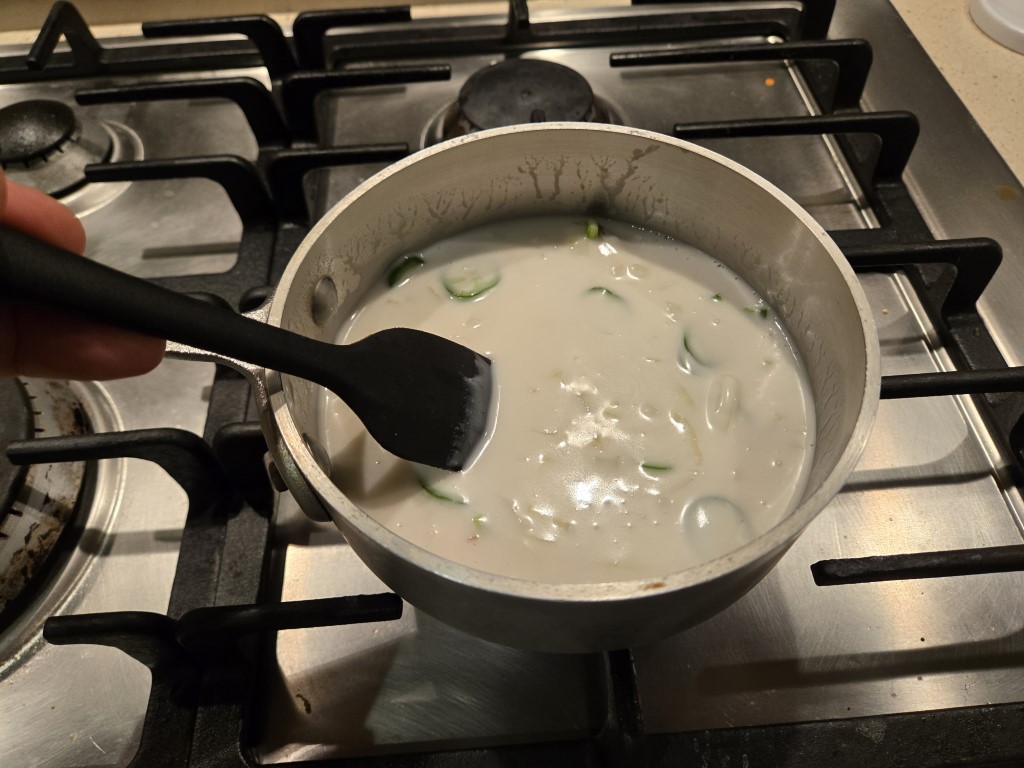
First you make a sauce with coconut cream, onion, chilis, lemon juice, and a little corn starch for thickener.

Coconut sauce

Next, you shake the fish in a container with a coating made of flour, salt, and white pepper. Barramundi would probably be the most common fish, but the store had black cod on sale, so black cod it was. Plus, black cod is delicious.

Fish ready to be dusted
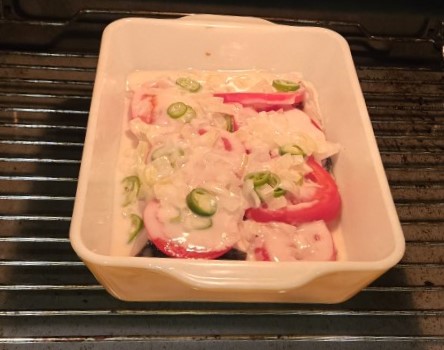
The fish gets lightly browned in oil, and then baked in the sauce with a layer of tomato slices on top.  I definitely think we’ve probably wandered a bit from traditional Marshallese food here, but here it is.

Fish baking

While the fish bakes, we had a go at two more dishes, a pumpkin rice porridge, and chuck chuck.

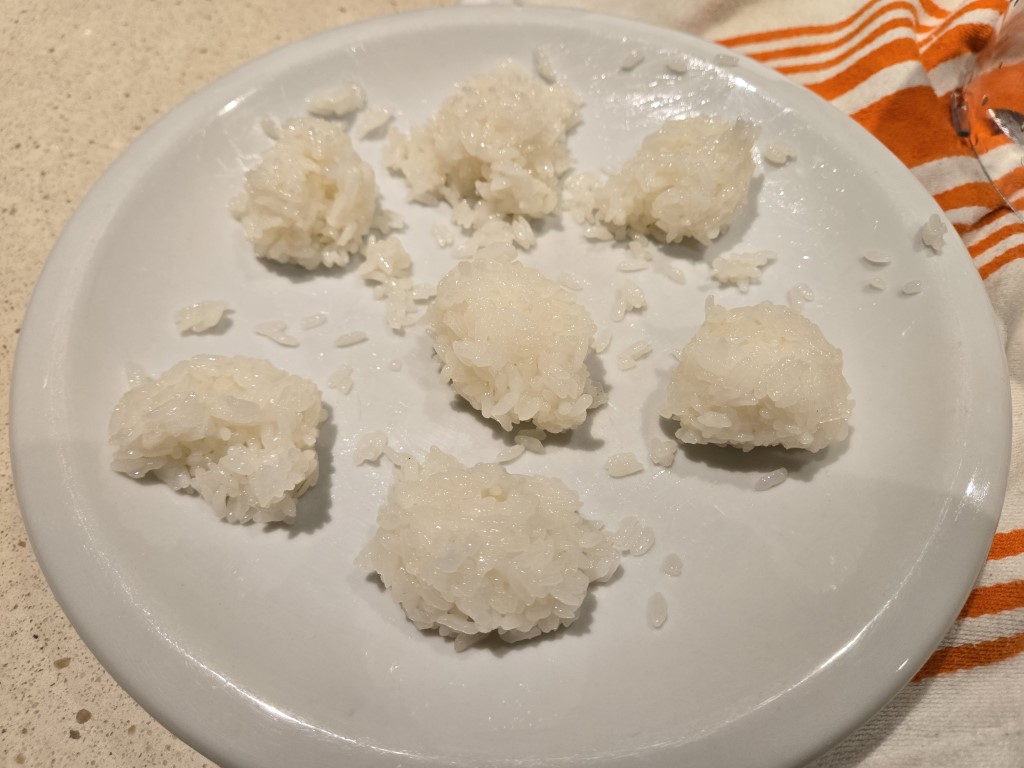
Chuck chuck is simplicity itself: make some sticky rice, roll it into balls with a little sugar and salt, roll said balls in coconut.  One problem – our sticky rice, for once, turned out not at all sticky, so we ended up with rice piles, rather than balls.

Rice "balls"

The pumpkin rice dish had recipes that were more vibes than anything else – “Boil the pumpkin until tender, add rice, cook until done, add coconut milk, and cook until absorbed.”  But since all the sources agreed that a) these were, in fact, the steps in the process and b) sweating the details was likely not critical, we went with it.

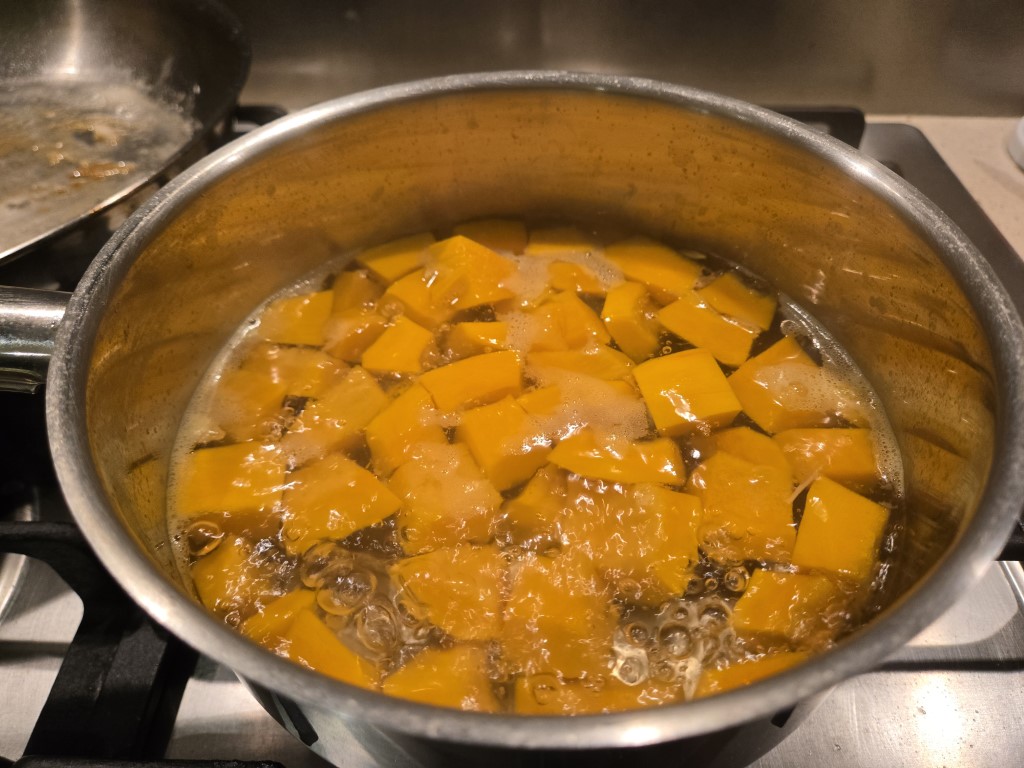
Pumpkin:
Pumpkin cooking

Pumpkin + rice:
[photo missing]

Pumpkin + rice + coconut milk:

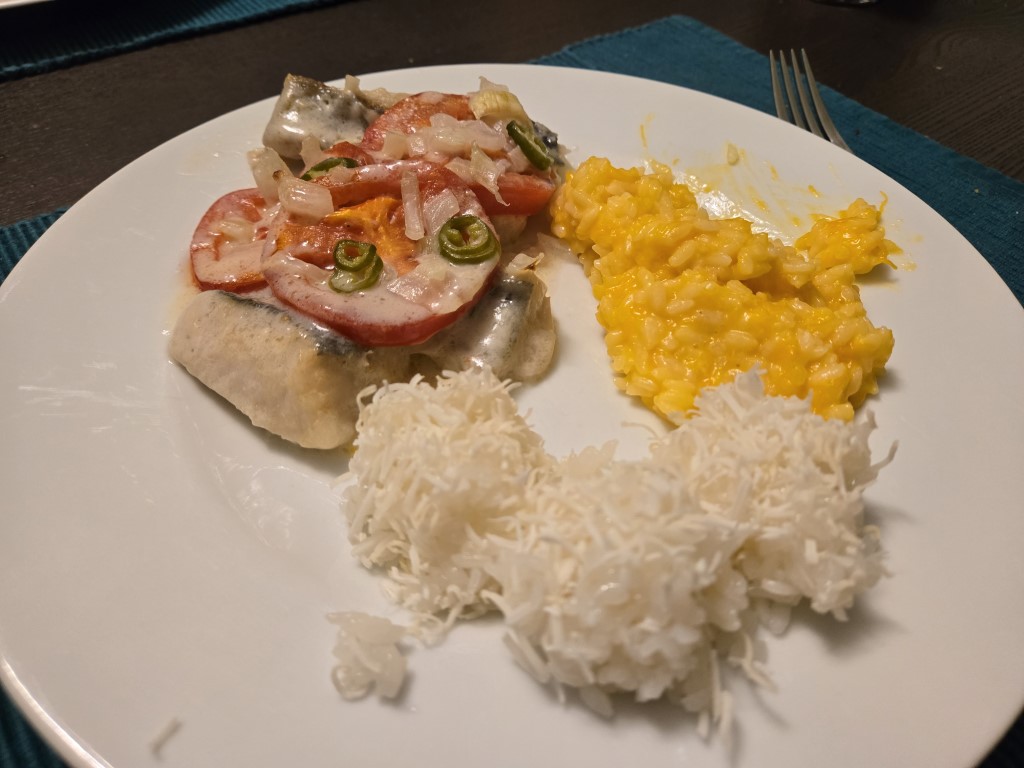
Well, we didn’t take a photo specifically of that step either, so here’s the whole meal on a plate.

Isn’t that yellow color pretty?  It’s entirely from the pumpkin.

For all the various hiccups, this meal goes hard. The rice, er, piles may not have ended up as finger food, but the sweet and salty flavor with the coconut was excellent.  May have to try this one again as a weeknight side.

The pumpkin rice porridge was hearty and delicious.

And finally the fish.  My heavens, the fish.  The ingredients weren’t all that complicated, but as mentioned earlier – black cod is delicious, and the sauce fused the chilis, coconut, and lemon juice together brilliantly.  The tomatoes, in particular, were so tasty when infused with the sauce, that I frankly do not care if they are remotely authentic.

And now, let’s make a macadamia nut pie.  At least, once we recover from the sticker shock.

Macadamia Nuts

I will point out that these two small bags of nuts constituted half the cost of the entire meal.  And black cod ain’t cheap, either.

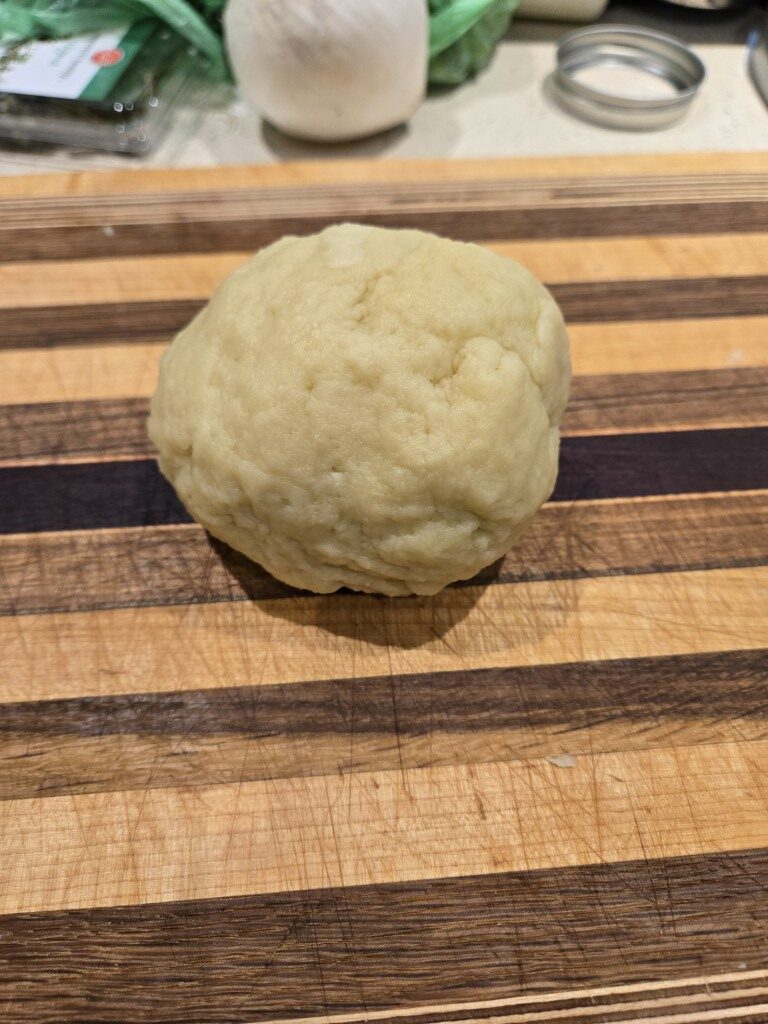
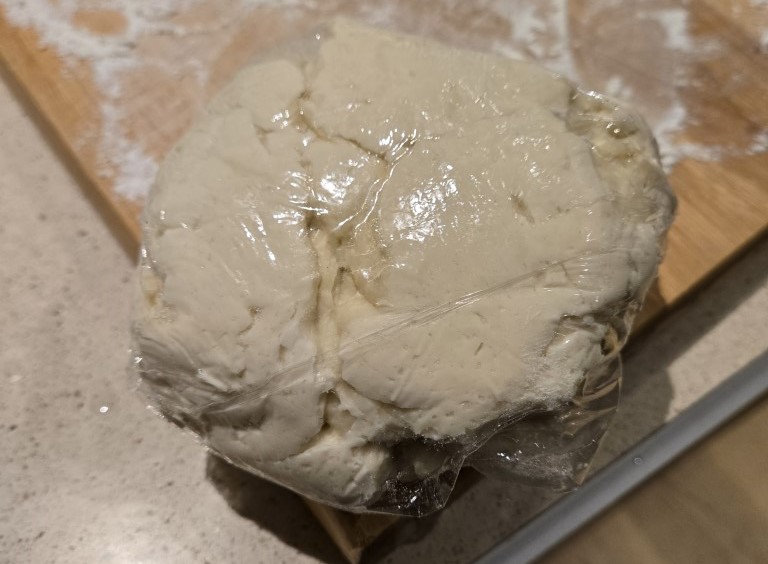
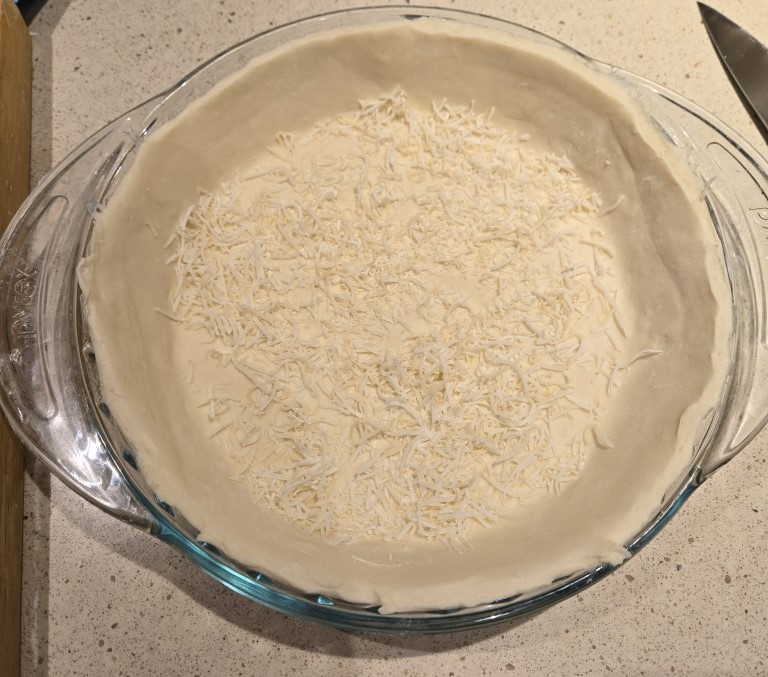
But it’s the national dish, so let’s do this.  First off – scratch pie crust. Pulse dry stuff in blender, then add wet until it coheres. Wrap in plastic, rest in fridge.

Dough resting

We’ve watched lots of Bake Off – how hard can this be?

Oh wait. We’ve watched lots of Bake Off – we know EXACTLY how hard this can be.  But the dough rolled out nicely, and rather than a blind bake the recipe we found called for dusting the bottom of the crust with coconut.

Pie crust
The filling is a sugared coating for the nuts, similar to a pecan pie.  It consists of either corn syrup or honey, (the former is likely more common, but for obvious reasons we went with the latter) butter, coconut milk, light brown sugar (which is apparently “golden” sugar here in Canada), and eggs.

You just mix those ingredients together, fold in the nuts, pour that into the shell, and bake.

Then 30 seconds later, you realize you left out one bag of your absurdly expensive nuts, yank the thing out of the oven, and toss those in to keep baking.

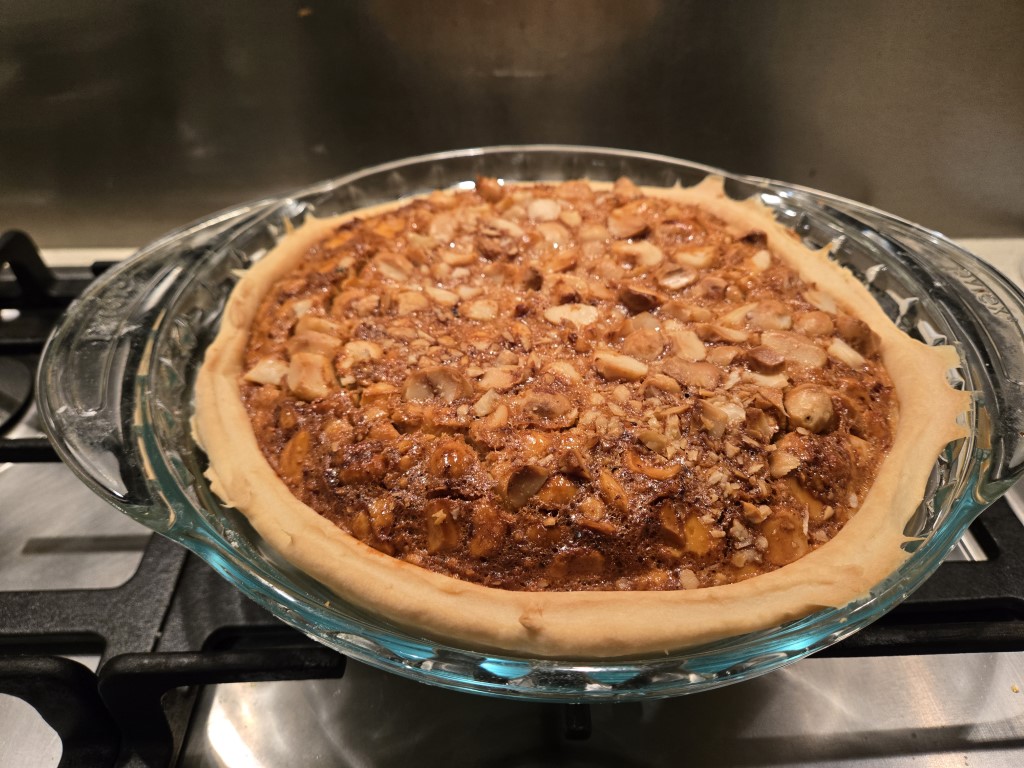
Honestly, I don’t think that was the issue – rather, I suspect blind baking WOULD have helped the crust be a little less doughy at the end.  Still, you can’t see that in the picture, can you?

Macadamia pie
There was one more minor hiccup before serving – you’re supposed to make a coconut whipped cream to go on top, but I didn’t realize you have to whip the cream BEFORE you add the coconut milk, or it won’t set up.  Lesson learned.

A quick nip over to the grocery store, and it turned out they HAD coconut whipped cream on the shelf, pre made an ready for topping.

Which we did.  And it was good. As was the pie itself.  I mean – macadamia nuts in sugar and honey – how can you go wrong?

The Marshall Islands may have a depressing past and future, but their present seems to be delicious.

Next up – Mauritania!

Recipes:
Coconut Fish
Chuk Chuk
Pumpkin Rice Porridge
Macadamia Nut Pie

International Meals – Malta

Hooray Malta!

Maltesers - Wikipedia

(Checks notes)

OK, I am informed that Maltesers have nothing to do with Malta.  Dammit.

OK, what DOES have to do with Malta?

Well, lets see – the island has at various times been ruled by Phoenicia, Carthage, Greece, Rome, Arabs, Normans, Aragonese, Knights Hospitalier, France, and Britain.  It became independent in 1964, and is so small and densely populated that the entire country is essentially considered one big urban region. Its capital city, Valletta, is the smallest capital in the EU by both population and area.

Also, it’s real pretty:
Valletta - Wikipedia

Like last week, I’ll point you to an Overly Sarcastic video for more information.

But let’s talk food.  The most commonly named option for the national dish of Malta is Stuffat tal-Fenek, a rabbit stew made with red wine.  Well that sounds tasty – lets get us a rabbit.  That’ll be photogenic, right?  Sure would have been, if I had remembered to take a picture BEFORE dismembering it.

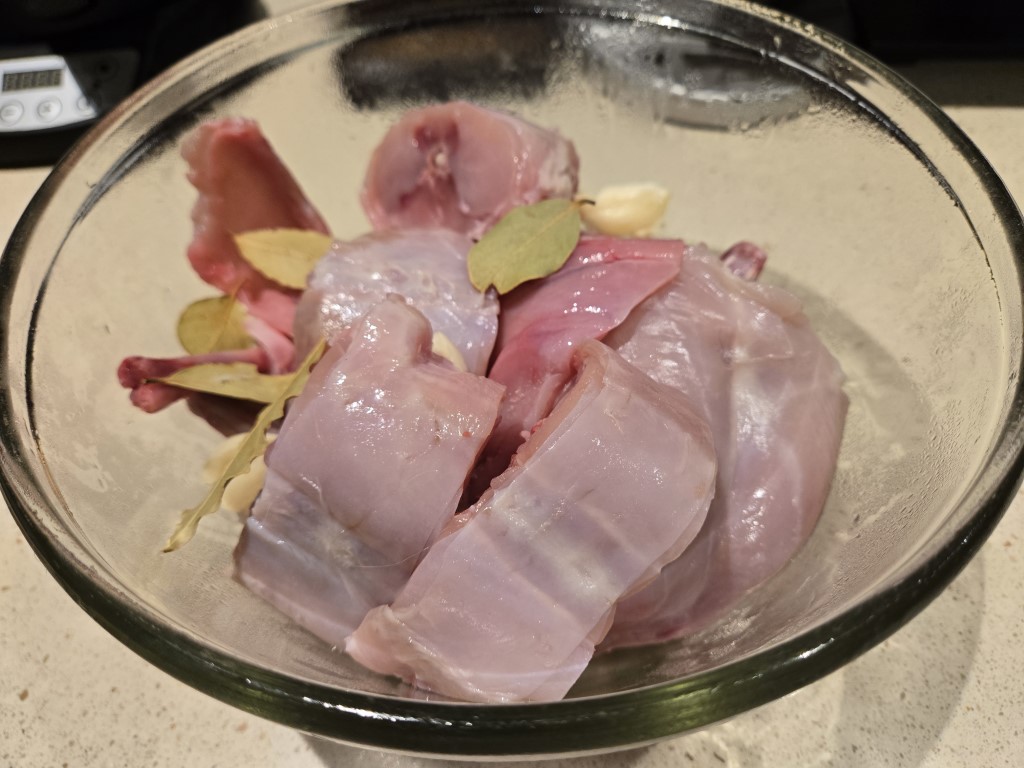
Jointed rabbit

A bowl of rabbit parts with some bay leaves and garlic is less impressive, but trust me, it was a whole rabbit before I got started.  Thanks to Jamie Oliver for the instructional video on the deconstruction. This got marinated for most of the day in “cheap and cheerful” red wine.

But before we get on to dinner, there’s another rabbit bit to talk about:

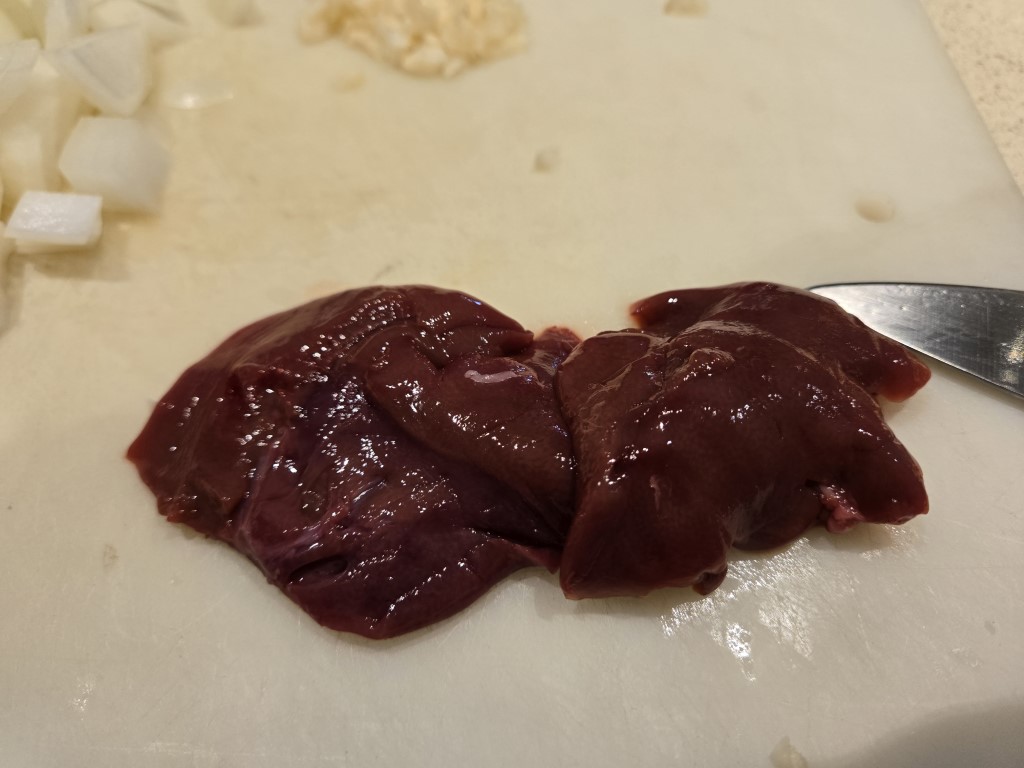
Rabbit Liver

This is the rabbit liver, and it’s considered a delicacy in many quarters.  A traditional thing to do with it is to scoop it out of the stew and use it to make a pasta sauce which is served over noodles as a first course.  That sounded like a LOT to do all at once, so instead I made a pasta sauce with it that we had for lunch.

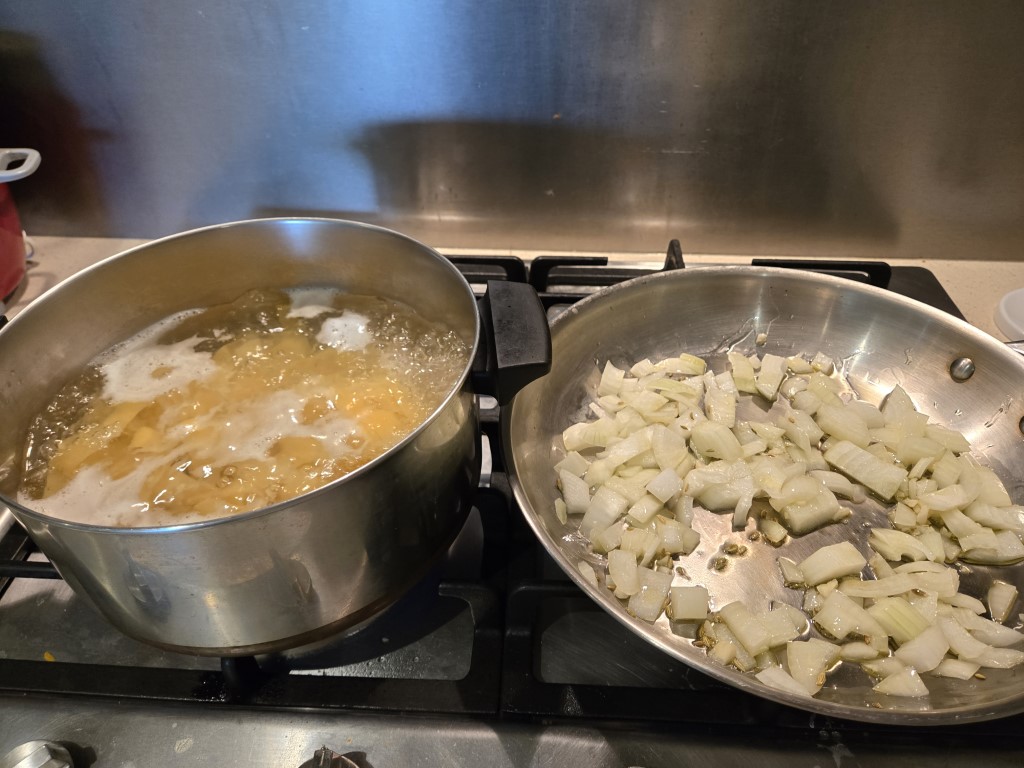
First you sweat some onions while the pasta is boiling:

Onions and pasta

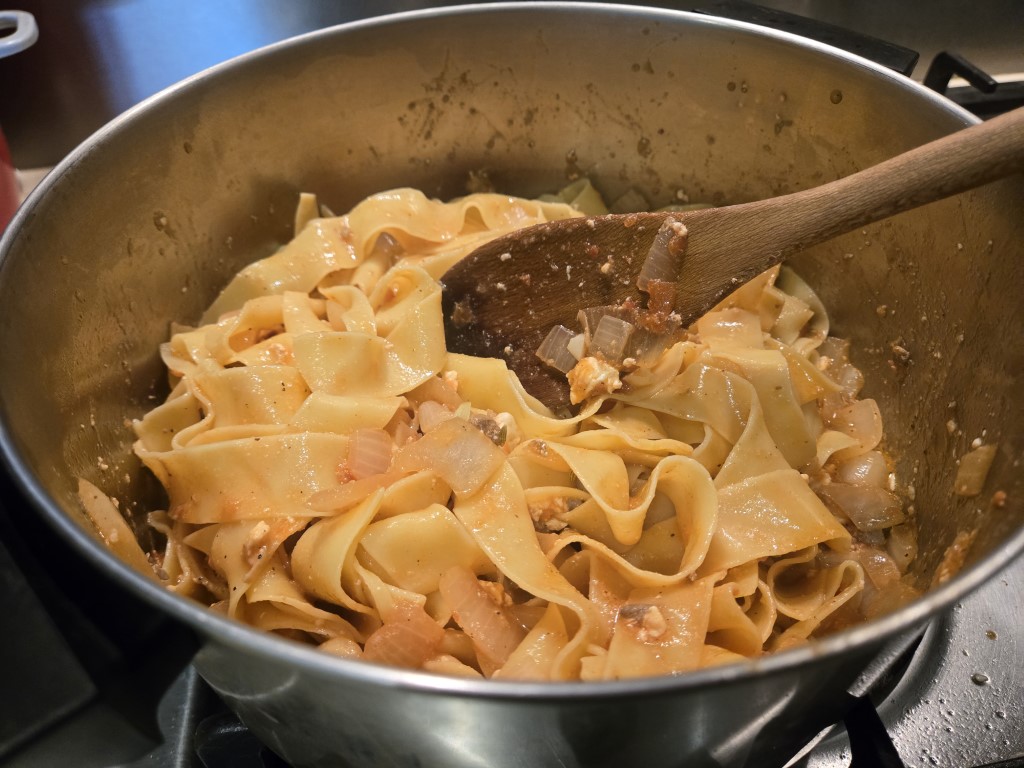
Then you brown the livers, and use this as the base of a tomato pasta sauce.  This sauce calls for a number of ingredients for which we had to make substitutions.  For example, it calls for a “Maltese Cheeslet.”

I am informed that I am no longer allowed to use that as a pet name for Leigh.

So failing that, I just got some feta cheese.

It also calls for a fancy sounding ingredient called “Cucina d’Oro Cooking Sauce.” I can find LOTS of hyperbolic language describing this product online (largely from the manufacturer) but very little about what it is actually intended to DO in a dish. It appears to be powdered buttermilk in a matrix of palm oil and starch.

I just used heavy cream.

There’s also some chili powder and fennel seed in here.  It’s actually quite a delicious sauce when you get done making it.

Rabbit liver pasta sauce.

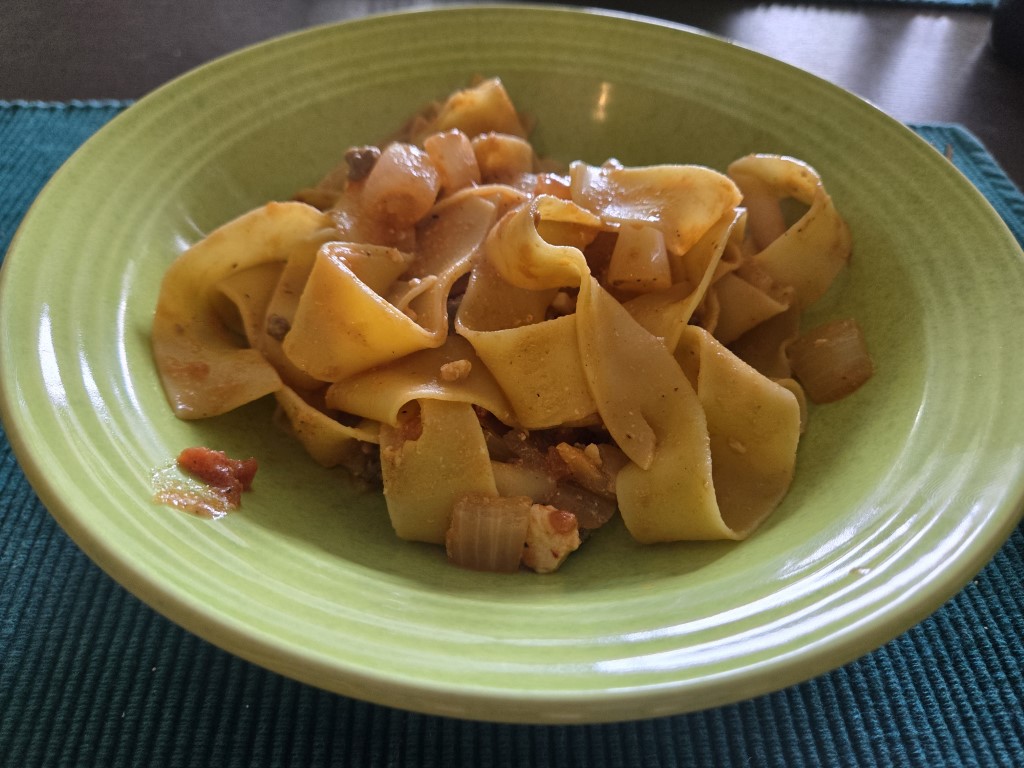
And that was lunch.

Rabbit Liver Pasta

Moving on to dinner, the first step is to take the rabbit out of the marinade and sear it on all sides.

Rabbit seearing

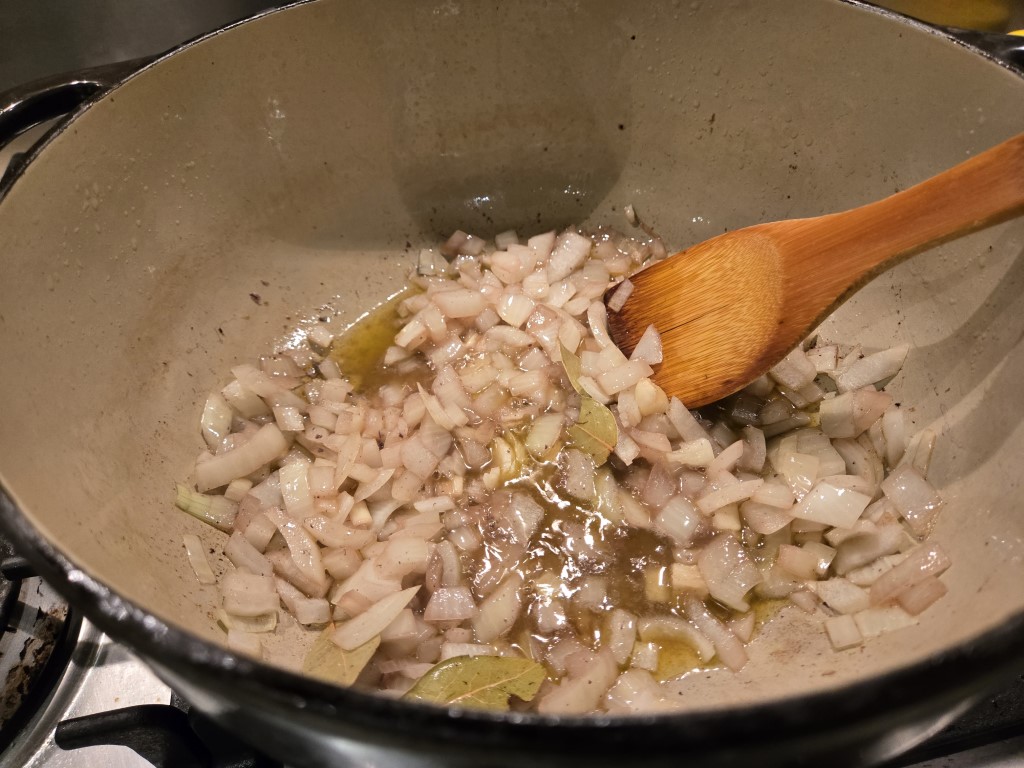
That accomplished you then, (what else?) sweat an onion with some garlic and bay leaves.

Onions sweating

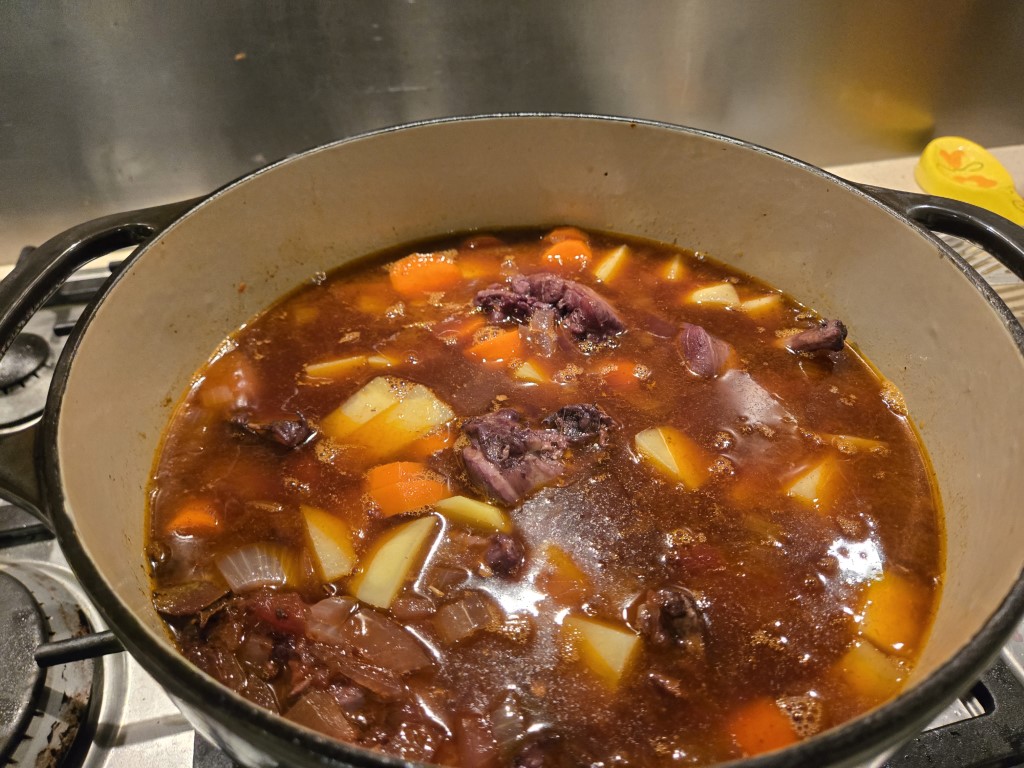
This being a stew, the cooking process from this point forward is “put stuff in the pot, cook it for a while, put more stuff in the pot.”  That included the marinade (which, recall, is basically just red wine), carrots, potatoes, tomatoes, more bay leaves, and salt and pepper.  Then it just… stews for a while.

Rabbit stew

Despite the fact that this stew CONTAINS potatoes, the suggested side dish for the recipe we found was… potatoes.

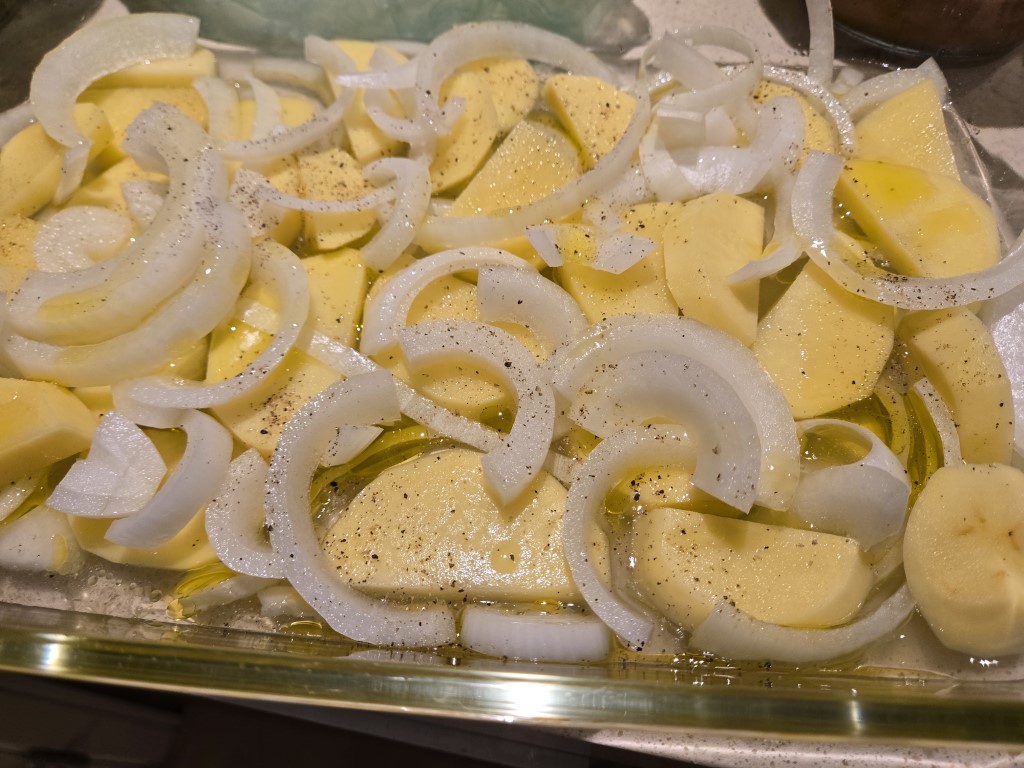
So – slice the potatoes medium thick, layer with onions and olive oil, and cover with foil. (Foil not pictured)

Potatoes ready for cooking.
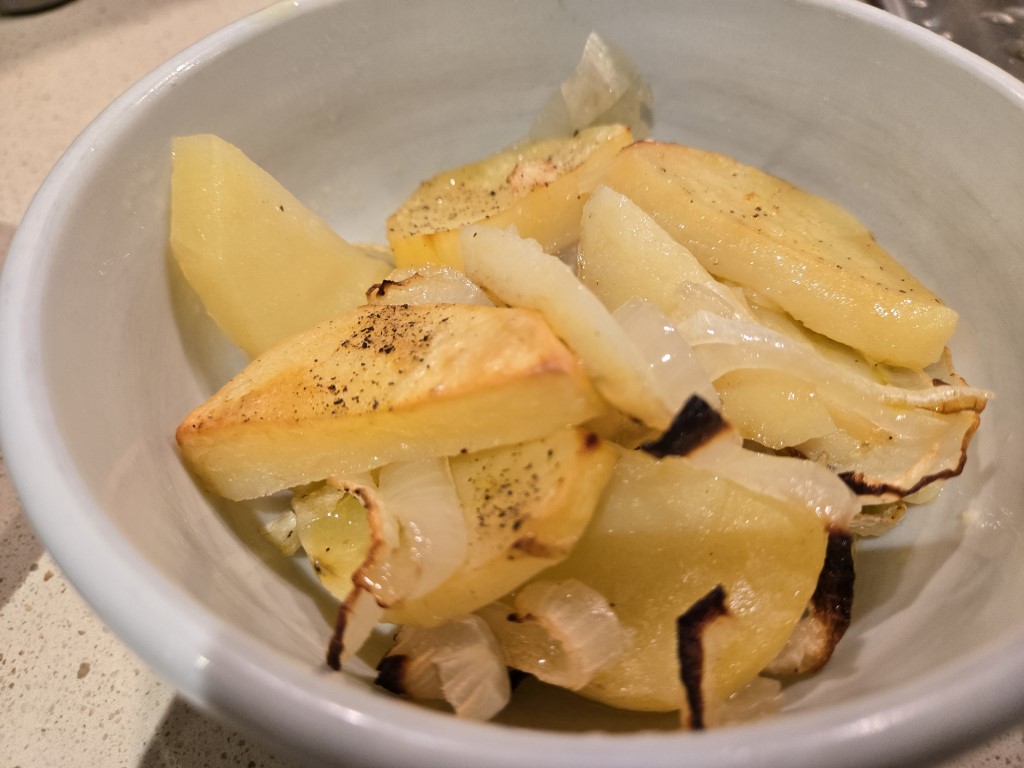
The idea is that you steam them for about 45 minutes in the foil to get them nice and soft, then take the foil off and let them crisp up on top.  The former happened, and they did crisp up some but we were hungry and the stew was done, so we popped them out when they looked like this.

Maltese potatoes

They were pretty good, but for leftovers I’m going to add some cheese.

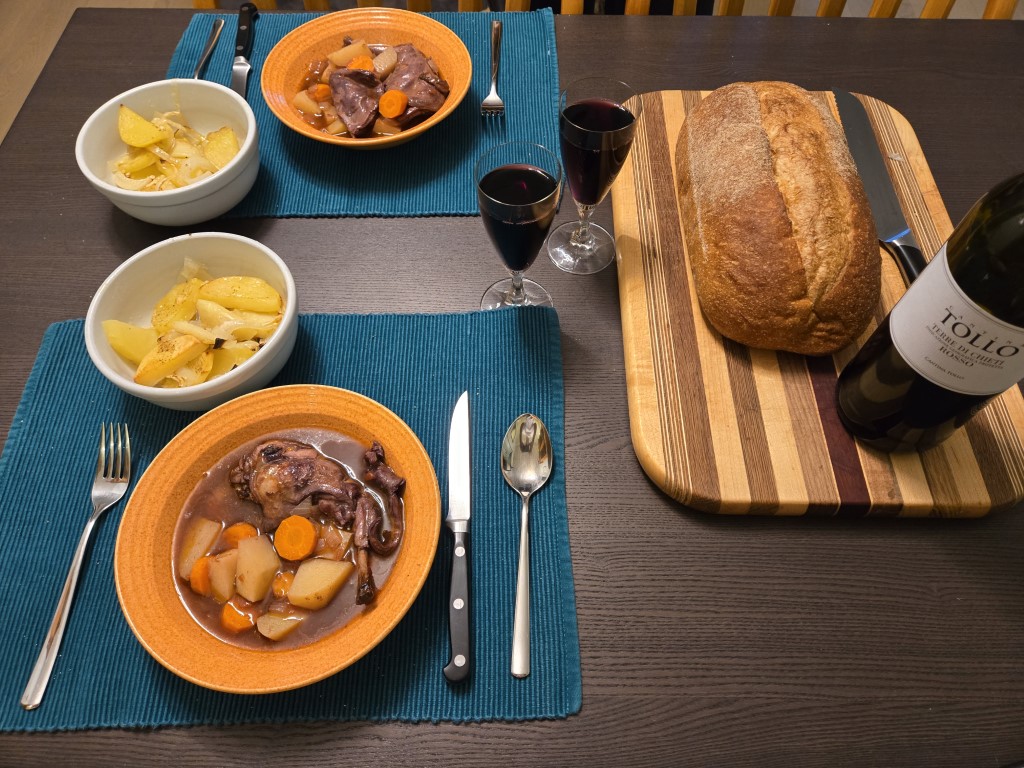
And here’s the final spread:

Maltese meal
Not bad, right?  The rabbit was nicely cooked without being tough, and the stew was quite flavourful.  That flavour being basically “red wine,” but we LIKE red wine.  The potatoes on the side had quite a different texture than the potatoes in the stew, so they didn’t feel redundant.

And it was good!  The rabbit was a bit pricey, but we got a TON of leftovers out of this meal, so no worries there.

Next up – The Marshall Islands.

Recipes:
Stuffat tal-Fenek (Maltese Rabbit Stew)
Patata fil-fom (Maltese style potaotes)
Rabbit Liver Pappardelle

International Meals – Mali

I feel a little bad about this one.

There’s a dish that’s mentioned on a lot of sites as the national dish of Mali, which is a stew called Tiguadege Na.  I found a recipe with a reasonably promising looking source.

But – I feel like we just didn’t quite DO enough.

Also, it’s remarkably similar to the dishes we made for Chad, the Gambia, and the Central African Republic, so I wonder if we should have tried harder to find something a bit more unique?  There’s lots of reasons why the African countries are frequently challenging, and also somewhat problematic, which I talk about a bit on the CAR page.

So anyway, Mali.  Fascinating country with a lot of really interesting history.  Timbuktu is in Mali.  You can learn more about that in this video. 

All that said, here’s the dish.

Brown some meat, then add onions and garlic until they’ve softened.  Our local Save On Foods had some wildly varying sizes of stew meat on offer, but since we were going to braise it forever, it didn’t really matter.

Meat and aromatics

Add tomatoes, broth, peanut butter, and Herbes de Province. I’m assuming the latter is due to the fact that France was the colonial aggressor in this part of Africa.

Finally, toss in carrots and potatoes and stew forever.

Stew in progress

It ended up being tasty, but much more watery than in the recipe photos.  If you try this one, I might consider doubling the peanut butter at least.

Peanut Stew

And that’s Mali.  They can’t all be huge production numbers, I suppose.  Next up, Malta!

Recipe:
Tiguadege Na

International Meals – Maldives

It’s been a few months since we did one of these meals.  Can’t imagine why.

Oh wait – see the preceding 24 entries on this blog for the reason why.

But we’re back, and it’s time to get back on our nonsense.  Heretofore unfamiliar specialty ingredient?

Canned tuna
Chec… oh no wait, that’s tuna.  OK, as I said – unknown specialty ingredient?

Fresh tuna
Chec… no, hang on, also tuna. One more try.

Dried tuna flakes

OK, this is ALSO tuna, but it is, nonetheless, a heretofore unfamiliar specialty ingredient.  Specifically, it’s dried tuna flakes.

Dried tuna

I’m sensing a theme here – where IS this country?

Maldives from Google maps.

Ah.  That explains all the tuna.

The Maldives have a population of half a million people, concentrated on a surface area the size of Fresno, making it the second most densely populated country in Asia. (after Singapore.) On the other hand, that surface area is spread out over a region the size of Maine, making it one of the most spatially dispersed countries in the world.  So that’s neat.

Also, they apparently eat a lot of tuna, because the two plausible dishes I could find as the most iconic are (checks notes) a tuna soup, and a cold tuna salad.

Good thing we LIKE tuna, then, innit?

OK, let’s make the salad, which is called Mas Huni. It is frequently eaten as a breakfast dish. You can find a bunch of different versions of it online, but some of them are so simple it didn’t feel like we’d be putting in sufficient effort. This one at least meant I had to get in the car to go get the dried tuna flakes.  (While I was at it, I also got some South Asian spices I’d been meaning to pick up, and then I went across the street and got donuts.)

And even for this, maximally complicated version, the process is “put everything in a bowl and mix it up.”  Everything in this case being canned tuna, tuna flakes, coconut, grated onion, green chilis, coconut milk, and some cilantro.

Mas Huni

Bam. Done.  What next?

The tuna soup is called Garudhiya, and there’s basically no difference in the recipes I found online.  First you poach the tuna for a bit, then you toss in some onions and curry leaves and poach it some more.

Garudhiya cooking

Salt to taste.  Is that all?

Well, we did one more thing, and it was the most time-consuming, but only because it’s a flatbread, so you have to cook them one at a time.  To make these Huni Roshi, you make a simple dough of flour, water, coconut milk, and shredded coconut, and then you just cook them in a pan.

Huni roshi dough

Like any batch cooking item (looking at you, pancakes) the first couple didn’t turn out so great, but they got better as we went along.  And that was it.  Here’s the full spread.

Maldives meal
Tuna, tuna, and bread for eating tuna.  And you know what?  It was pretty good.  The tuna soup was subtle, but that meant the tuna and curry leaves got to speak for themselves.  And the Mas Huni was extremely flavorful – the lime juice, coconut, and chilis really perked up the tuna to make something really tasty.  The leftovers got polished off for lunch on the next two days, which says something.

And that’s the Maldives!  They were tuna-riffic.

Next up, Mali!

Recipes:
Mas Huni and Huni Roshi
Garudhiya

International Meals – Malaysia

We have had generally good luck with southeast Asian food so far.  Cambodia, Laos, East Timor, and our three Indonesian meals were all bangers. (I mean “very good,” not “British sausages” here.) We were less happy with Brunei, but I think that’s more down to skill and ingredients than it is to any inherent flaw with the cuisine.

But seriously – if you’re looking for some great food ideas, go check out any of those entries and give them a shot.

So we were excited for Malaysia.  We picked out two dishes to make, since that’s not too much work to do all at once, right?

Fortunately,  we came to our senses and decided to make one for lunch and the other for dinner, since it was Victoria day.  (Yay, Canada!)

For lunch, we decided to go with a strong candidate for the national dish of Malaysia – nasi lemak, which literally means “rich rice.”  It’s rice cooked in coconut milk, flavoured (yay, Canada!) with a panda leaf.

Wait, what?

Pandan leaf with label spelled "Panda"

Typos aside, that is a pandan leaf, which has a lovely sweet fragrance, and flavours the rice beautifully.  All we had to do was toss the rice, leaf, and coconut milk into the rice cooker and press “go.”  This is easy – why did we decide not to do both dishes at once, again?

Nasi lemak ingredients

Just like building an IKEA bookshelf, there appear to be a few ingredients left over here.  What’s going on?

Well, nasi lemak isn’t just about the rice – it’s also about the accompaniments.  Most important is the sambal, which is one of those generic words like “salsa” or “curry” that has to be narrowed down a bit.

The sambal we’re making here involves first soaking some chilies and tamarind.

Chiles and tamarind soaking

Sorry, did I say “some” chilies?  I meant “many”. Many, many.

Once those are softened up, they get tossed in a blender with onions, garlic, and tiny, tiny anchovies, which we last encountered in our first Indonesian meal.  After a quick blitz, the paste gets fried for a solid twenty minutes, until the oil separates.

Here’s what it looked like at the start of cooking:

Sambal nasi lemak at the start of cooking

And twenty minutes later, at which point we also added dark soy sauce and the tamarind.

Nasi Lemak Sambal

In addition to the sambal, we also fried some peanuts and more of the anchovies, and sliced up a cucumber.  This may be some of the best presentation we’ve accomplished on here.

Nasi Lemak assembled

Are we ready to be world famous food bloggers yet?  Or even famous world food bloggers? I mean, no, of course we aren’t.  But that’s still a great picture.  And you know what else is great?

Nasi Lemak, that’s what.  The rice was delicious all by itself, but paired with the variety of flavours and textures from all the accompaniments it was an absolutely amazing meal.

OK – what’s for dinner?

A street food dish called Char Kway Teow, which literally means “stir fried flat rice noodles.”  It consists of the titular ingredient blasted in the hottest wok you can arrange with a dark sauce that caramelizes onto the noodles.  This thing goes FAST, so all you’re getting pictures of is the ingredient list, followed by the dish – there was absolutely no time for photography while the cooking was happening.

Here’s our ingredient family photo:

Char Kway Teow ingredients

Note the three different kinds of soy sauce plus oyster sauce.  That’s going to make the dark, sweet sauce that will provide the base of the flavour here.  Also pictured, Chinese chives, shrimp, rice noodles, garlic, Chinese sausage, fish balls (snerk.), eggs, and bean sprouts.

From that, our mise en place:

Char Kway Teow mise en place

Ready, set, BAKE! er… I mean STIR FRY!

Char Kway Teow

Oh yeah – that’s the stuff. Actual cooking time was something like 90 seconds, but we were super busy the whole time. And as you can see – the result was pretty exciting.  Trust us, it tasted as good as it looks. The sweet savoury salty sauce stuck to all of the other ingredients beautifully.  I’m getting hungry again just looking at this.

Malaysia was fantastic.  Rather than getting too worked up about Queen Victoria, let’s be happy that one of the countries her empire oppressed has REALLY amazing food.

Next up, the Maldives!

Recipes:
Nasi Lemak
Char Kway Teow

International Meals – Malawi

Whenever we discover that there’s some food item that is regarded as quinessentially associated with a country, we prick up our ears a bit.  It’s often so challenging to distinguish neighbors, that anything that is definitely from our target country is welcome news.

In this case, we discovered that there is a hot sauce that is made in Malawi, associated with Malawi, and eagerly sought by Malawian expatriates. It also costs three times as much for shipping as it does for the actual bottle.

Nali sauce
It is called Nali sauce, and friends – that label is not joking. The ingredients here are birds eye chilis, paprika, onions, and vinegar.

That’s OK, we like spicy.

So that’s Malawi sorted.

Wait a moment – don’t we need some sort of recipe to go with this?  As much fun as doing Nali shots sounds, shouldn’t we make some actual, you know, food?

And there we ran into difficulty. If I asked you to name a quinessential BRITISH sauce, you’d probably say “HP Sauce.”  Or else “Please go away and stop asking me questions about condiments.”  But either way – a sauce is not a recipe, and while HP is a classic UK sauce, that doesn’t mean you’d necessarily use it to make Boopers and Sploot, or whatever the hell the national dish is. (We don’t do research more than one country ahead.)

So returning to our old friends at United Noshes, (And by friends, I mean “people who have no idea we exist”) we discover that a common use for this stuff is on… fish and chips.  OK, we can do that.  Or rather, we can fry some fish and go pick up some french fries from our friendly neighborhood restaurant with a deep fryer.

I made a simple batter of flour and egg, which completely failed to adhere to the tilapia we selected.  The cooked fish was still good, but was completely uncoated.  The other topping in addition to Nali sauce was shredded cabbage soaked in vinegar.

In addition to that, let’s make the ACTUAL national dish of Malawi, which is another variant on a simple starch paste.  This one is called Nsima, and is made with fine corn flour, such as is used to make tortillas.

Corn flour

Flour, water, heat, stir.

Ndima

I don’t mean to be dismissive – this actually turned out to be one of the tastier ones we’ve made, and we have no idea why. It doesn’t even have any salt.

The degree to which the Ndima is intended to be the star of the show is indicated by the fact that the accompanying vegetable stew, (Ndiwo) is referred to as a “relish.”  There’s a zillion recipes for these things, but the one we used called for greens (we used amaranth), tomatoes, onion, and salt.

Ndiwo cooking

Red amaranth sure is pretty.

So our final meal consisted of a very traditional dish of cornmeal paste and vegetable stew, as well as a modern one of fish and chips with cabbage and hot sauce.

Malawian meal

Trust me, there IS fish under all those fries and cabbage.  You’d THINK that we’d just be hurrying past the cornmeal and veg to get to the fish and chips, but you know what?  We weren’t.  Still can’t explain exactly why, but this particular starch paste was really good, and it was even better the next day reheated.  The vegetables spoke for themselves, and combined nicely with the Nsiwa.

Which is not to say that french fries, fish, and hot sauce aren’t delicious, because they totally are.  And the crunchy sour cabbage was a nice contrast, as well as soaking up the SERIOUS heat from the Nali sauce.

All in all, a quite memorable meal.  Next up, Malaysia!

Recipes:
Nsiwa and Ndimo
Fish and Chips: Seriously – go buy some french fries, fry some fish, and put hot sauce and cabbage on it.

International Meals – Madagascar

*Taps Music Stand*

*Signals to Chorus*

“MAAAAAAAAA-DAGASCAR Where The Lemurs Come Roaring Off The Plains!”

ahem.

That is probably not how that goes.  I don’t think lemurs can roar.

But they are strictly confined to the island of Madagascar.  When Leigh and I were first dating, over twenty years ago (twenty…? Jesus Christ…), we somehow managed to gift each other not one but TWO stuffed lemurs, which we still have to this very day.  Their names are Chocolate and Vanilla.

Stuffed Leumrs

Oddly, despite the fact that the island is known for it, we managed not to include any actual vanilla in this meal.  Then again, we didn’t include any lemur either, so there you are.

We should really get on with this.  There are 17 “M” countries, so there’s no time to waste.

So what are we actually making?  The most plausible candidate for a national dish of Magadascar as far as I can tell is Romazava, a dish of zebu meat containing anamalaho greens.  Neither of which are we going to be able to acquire, so that’s off to a good start!

Zebu is at least just a type of cattle, so we’ll be fine there just using beef.  Anamalaho, on the other hand, is sort of key, since it imparts a numbing spice similar to Sichuan pepper.  Given that we’re not going to be getting that either, we used dandilion greens, on the theory that they would give a somewhat peppery flavor.  In addition, we mixed in spinach and watercress, as suggested by our recipe source.

Chopped mixed greens

Past that, it’s a pretty standard beef stew. We do, of course, begin by chopping and sauteeing an onoin.  It’s the law.  Here is stock onion frying photo #34591:

Sauteeing onion

You then brown the beef for a bit with the onions, then toss in a mix of ginger, garlic, green chili, tomatoes, salt, and pepper.  Simmer for a while, then add water, and let it braise with the greens for an hour.

Romazava cooking

Bim bam, easy.  What about a side dish?  We give you Lasary Voatabia – the world’s least complicated salad.  Tomatoes, scallions, salt, and hot sauce of your choice.

Lasary Voatabia

Gotta remember this one – it is ludicrously easy and really good.

And here’s our meal, along with a pile of basmati rice for serving.  (Apparently rice with EVERYTHING is the norm in Madagascar.)

Madagascar meal

Doesn’t that look tasty?  Unlike a number of the other African stews we’ve made where we committed to using the RIGHT leaves, at the expense of dealing with them frozen, here we used fresh leaves.  This may not have been perfectly authentic, but oh my goodness – the improvement in texture is SO worth it.

And this meal was great!  The stew was well seasoned, the peppery greens had lots of personality, even after the long cook time, and hotsauce tomatoes were a great side.  We don’t do a lot of these meals on weeknights, but this one posed no difficulties at all.

Next up, Malawi!

Recipes:
Romazava
Lasary Voatabia