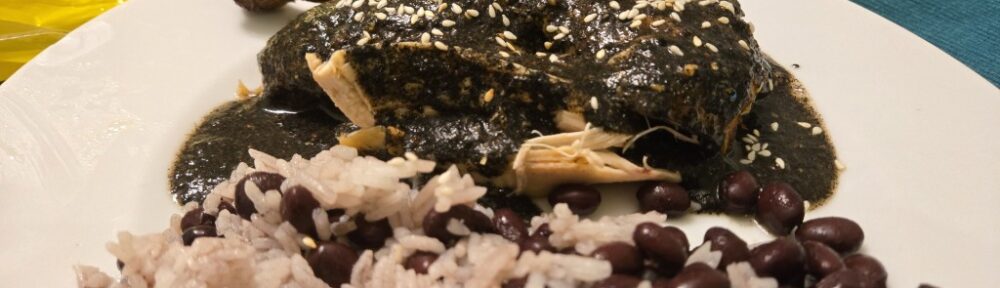
By my count, this should be about our 110th country, give or take. I don’t have an exact count for a few reasons. We didn’t start this blog until “Bosnia,” although at some point I will go back and transfer the old pictures off of Facebook. We also haven’t been consistent with our naming conventions – why “East Timor” but also “Côte d’Ivoire?” Why “Korea, North?”
Just… shut up, OK? That’s why.
Point being that we’ve done a LOT of meals at this point. And a number of countries have had food cultures so diverse and extensive that we just couldn’t bring ourselves to do just one meal. China got five. India got four. Italy and Indonesia each got 3, and France got 2. Again, no science to it, that’s just how we decided to do it.
But as we get into the second half of the alphabet, there’s not too many left that are screaming to be split up. I’m pretty sure we aren’t going to get four meals out of St. Vincent and the Grenadines. So with this meal we’re starting on what may be our last multi-meal country, Mexico.
And we’re using the same highly scientific process that we’ve used up to this point of “half-assing some research” to determine precisely which regions and meals will be represented. We’re aware that what you get at “Mexican Restaurants” in the U.S. and Canada is largely “Tex-Mex” cuisine, which is a very specific (and delicious!) fusion of influences from Northern Mexico, but also Texas.
We’re going to try to stick with more specifically Mexican influences for these three meals, and the three regions we’re going to attempt to highlight are Oaxaca, Jalisco, and “vaguely north.” Lots of planets have a North.
For Oaxaca, we’re going to make a single item. One sauce.
That’s right – we’re not even going to make the meat for this one. Just buying a rotisserie chicken and pouring our sauce over it along with a side of rice and beans. (Technically, we’re “making” the rice and beans, but that’s so little effort it doesn’t count.)
How can we justify this little effort? Let me cut and paste the ingredient list for this single recipe, shall I?
- 78 grams chilhuacle negro chiles
- 38 grams pasilla chiles
- 27 grams guajillo chiles
- 1/2 ripe plantain
- 2 Roma tomatoes
- 2 medium tomatillos
- 1/4 large white onion
- 2 garlic cloves
- 3 tablespoons lard
- 2 tablespoons almonds
- 1 tablespoon peanuts
- 1 piece cinnamon
- 2 whole cloves
- 1 whole star anise
- 1/2 teaspoon allspice berries
- 1/2 teaspoon black peppercorns
- 1 tablespoon pumpkin seeds
- 1 tablespoon raisins
- 1 tablespoon sesame seeds (plus more for serving)
- 1/2 teaspoon cumin
- 1/2 teaspoon thyme
- 1/2 teaspoon oregano
- 2 bay leaves
- 2 corn tortillas
- 5 cups chicken stock
- 4 teaspoons kosher salt
- 67 grams Mexican chocolate
That’s right – we’re making one of the most complicated sauces in all of global cuisine, black Mole.
Step 1 – roast the chiles. Wait – it’s the dead of winter! How can we grill…
…oh wait, we live in Vancouver.
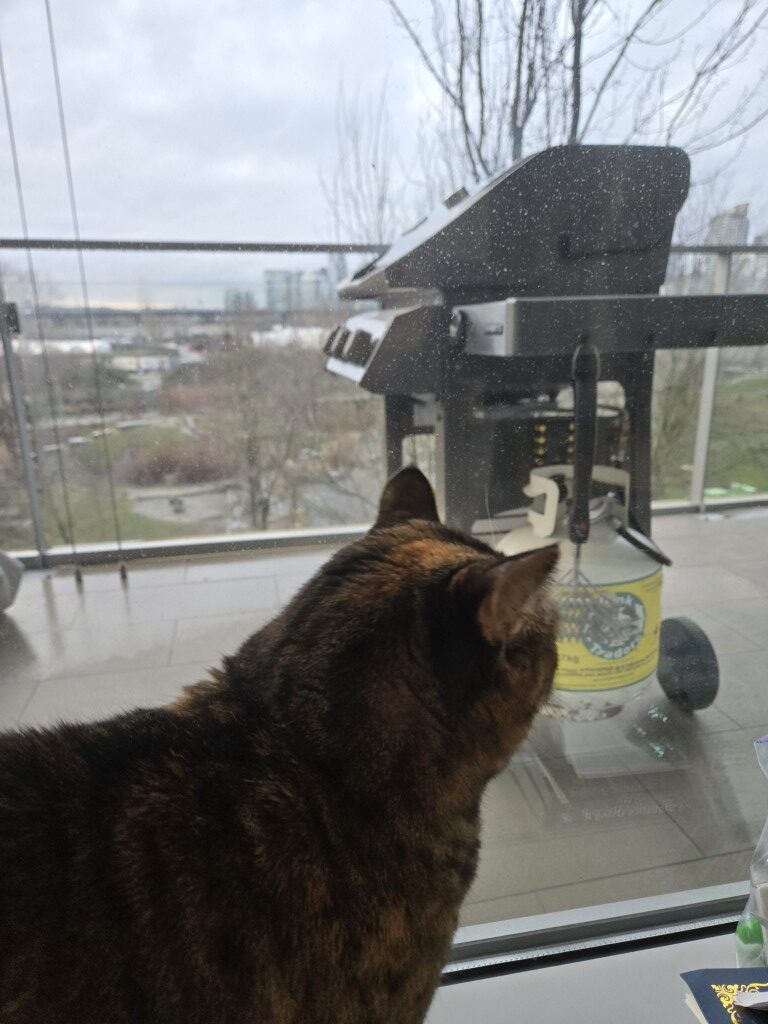
Honestly, this is still probably the step we did the least well. Martinez’s recipe (I had to look up how to properly punctuate that) stresses carbonizing the peppers on the grill and then washing and rehydrating them to remove the burnt flavor, but comments I’ve read since then disagree with this approach, and suggest it would have been better to pull them off a little sooner in the first place.
Before:

After:
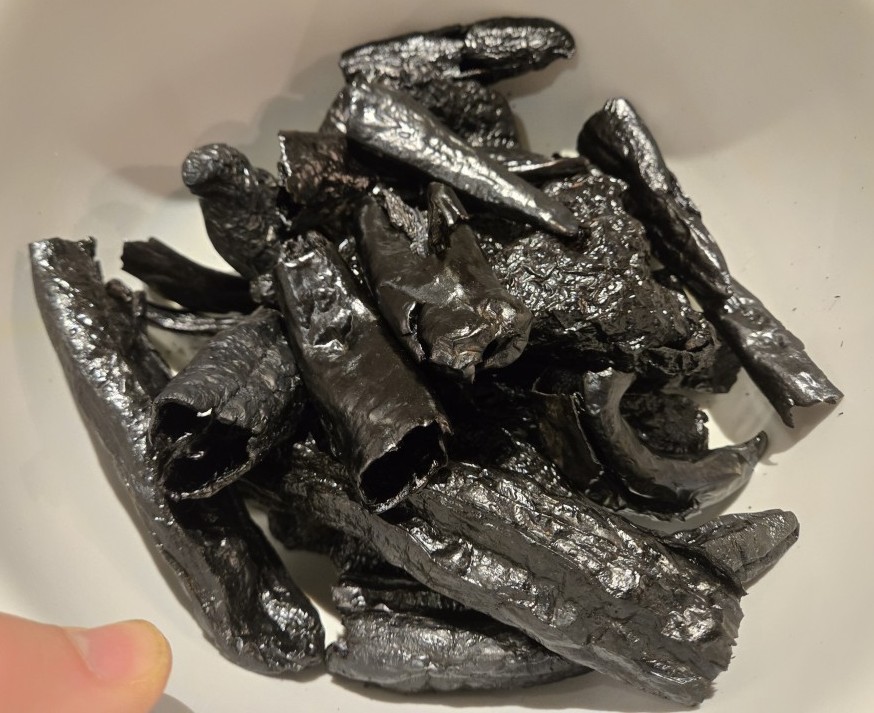
These were then washed and then left to soak in boiling water for an hour, which was intended to remove as many of the acrid notes as possible. While the grill was still hot, we tossed on half a ripe plantain, which, hilariously, attempted to escape from its skin over the course of 20 minutes.
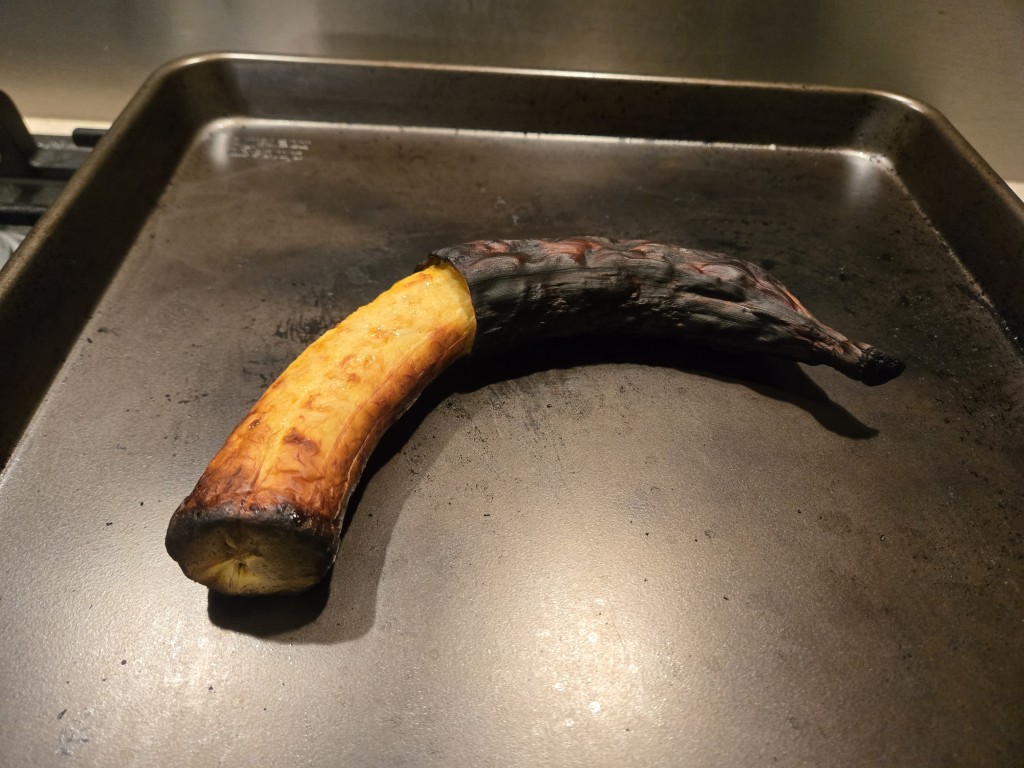
Note that the blackened skin on the left is empty – it contained the roasted plantain on the right when we started.
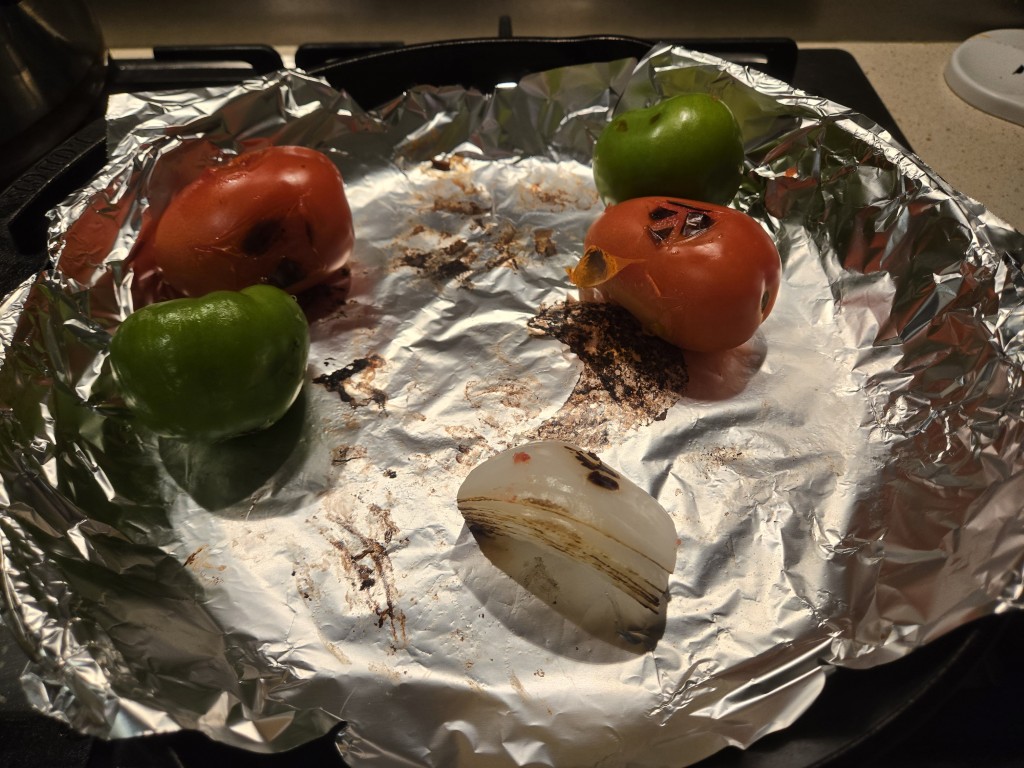
OK, what other prep do we need to do? We need to blacken our veg. I did this on a cast iron skillet, as instructed, but in future I might just haul out the blowtorch.
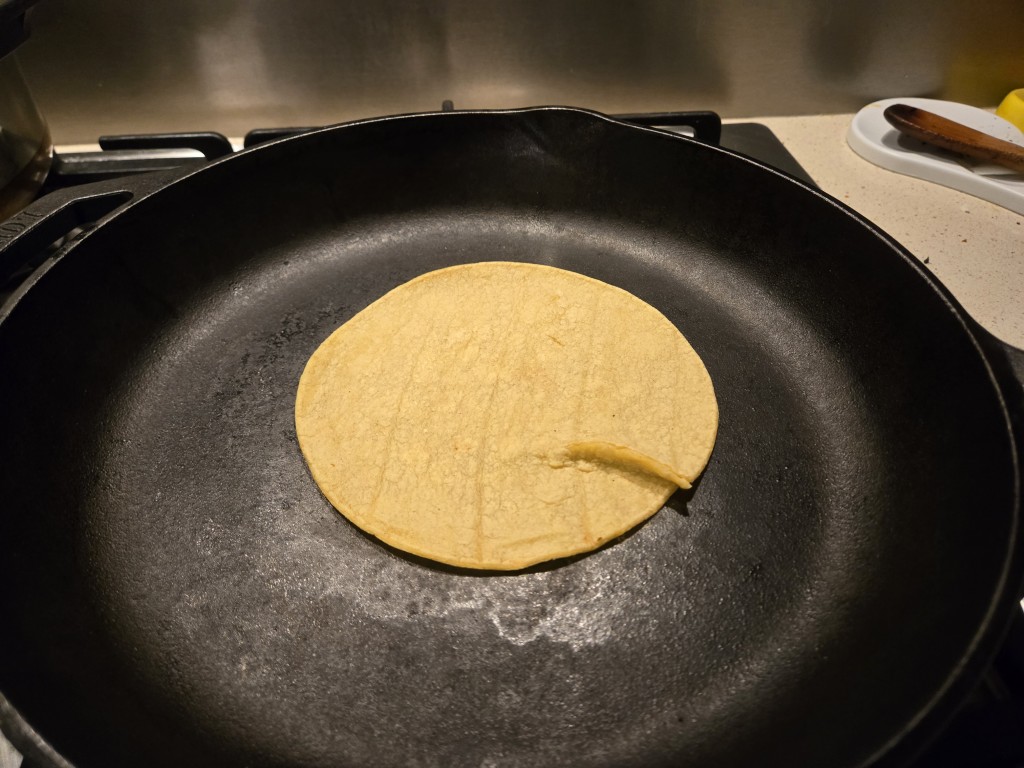
Need to toast a couple of corn tortillas, too.
The only other prep is to put all the ingredients in bowls so we can add them in the right sequence for the next steps.
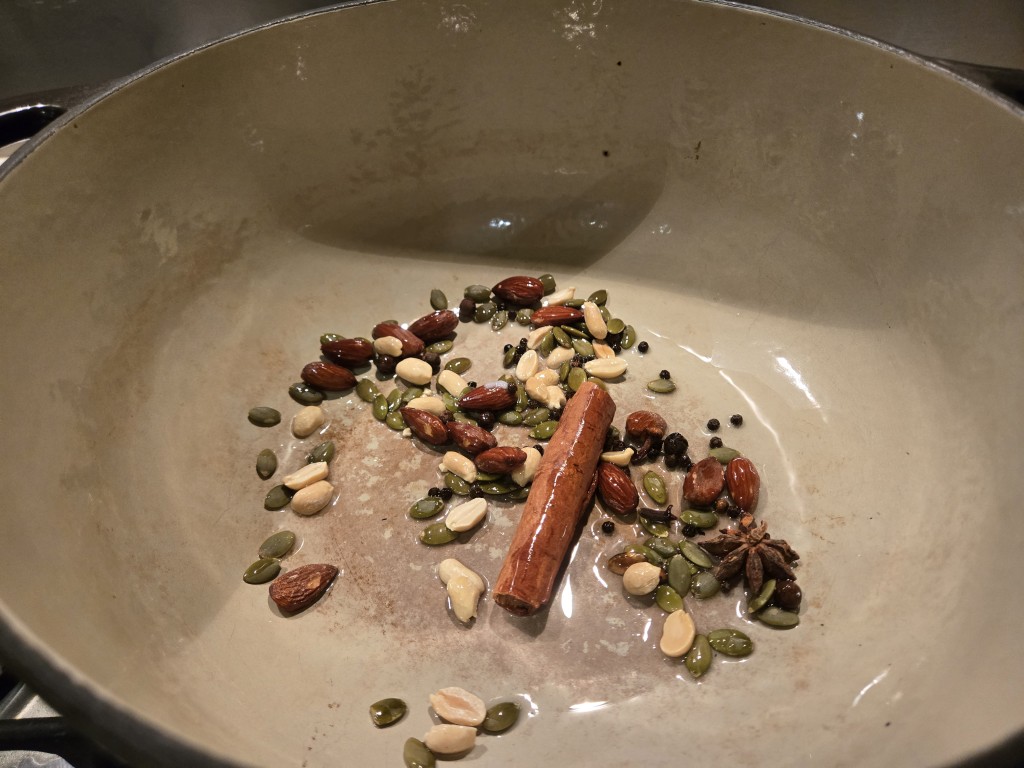
First up, melt the lard. Then in with the almonds, peanuts, cinnamon, cloves, anise, allspice, peppercorns, and pumpkin seeds.
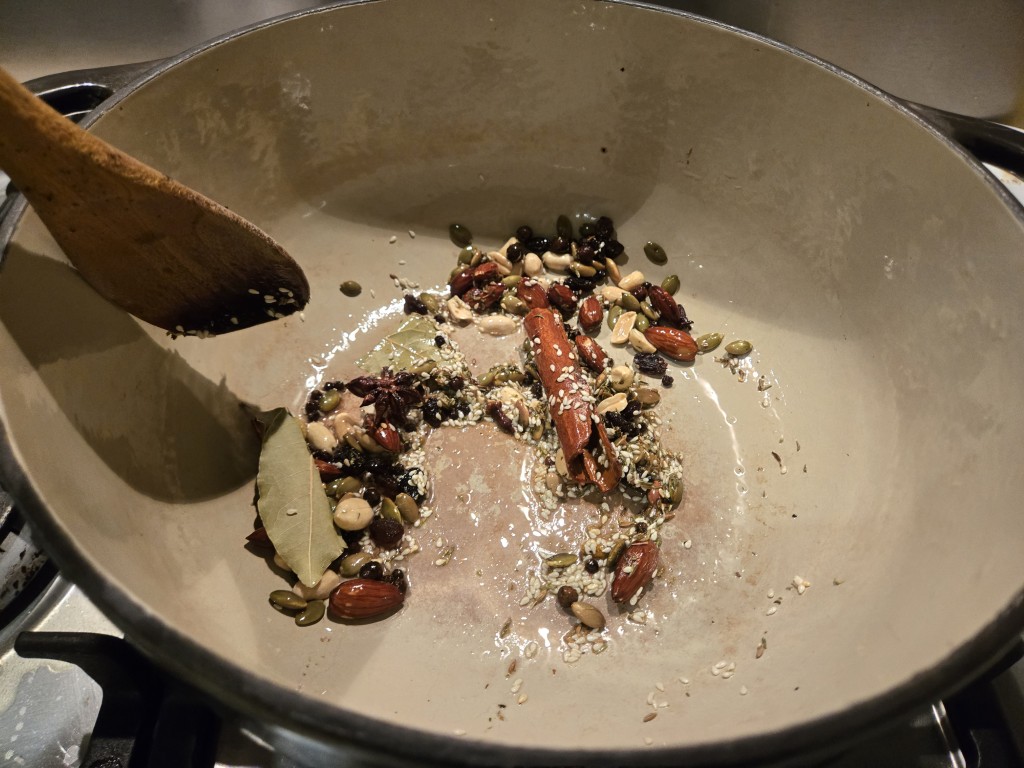
Next, raisins, sesame seeds, cumin, thyme, oregano, and bay leaves.
Once those have had a chance to toast a bit, in with almost everything else: chiles, plantain, veg, tortillas (yes, straight into the sauce), stock, and salt.
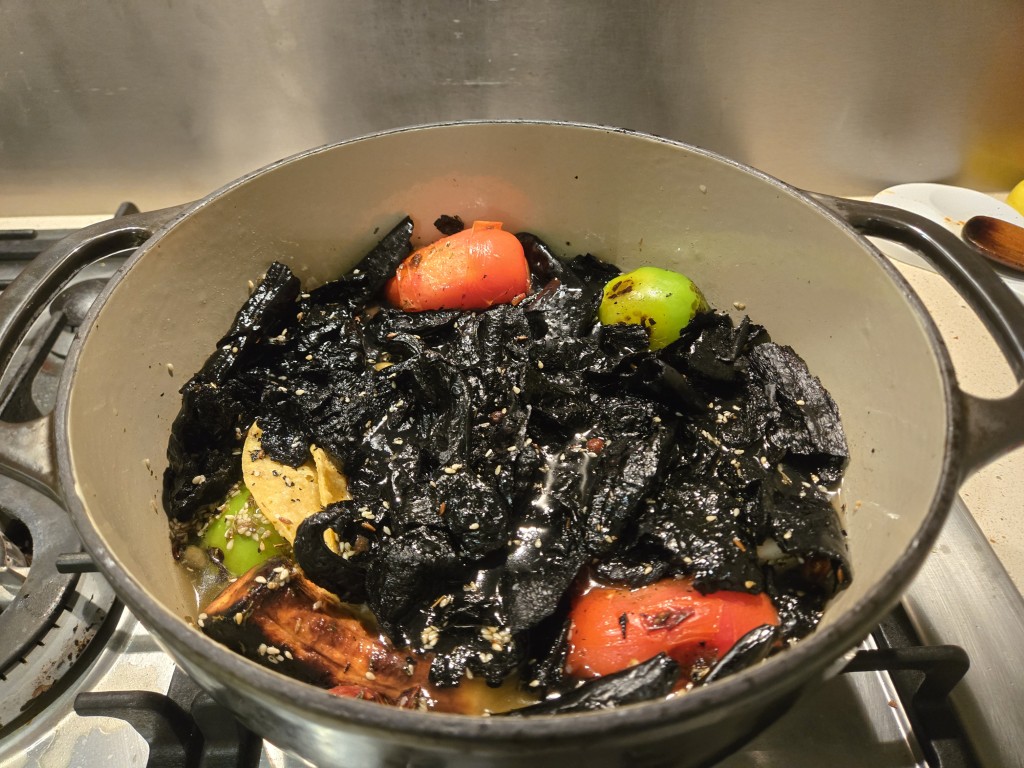
This gets simmered for an hour or so, then the whole mess goes into the food processor.

Once it’s all blended, you transfer it BACK to the pot with some more lard and then cook it for another ten minutes. When it’s finished, you turn off the heat and then stir in the chocolate.
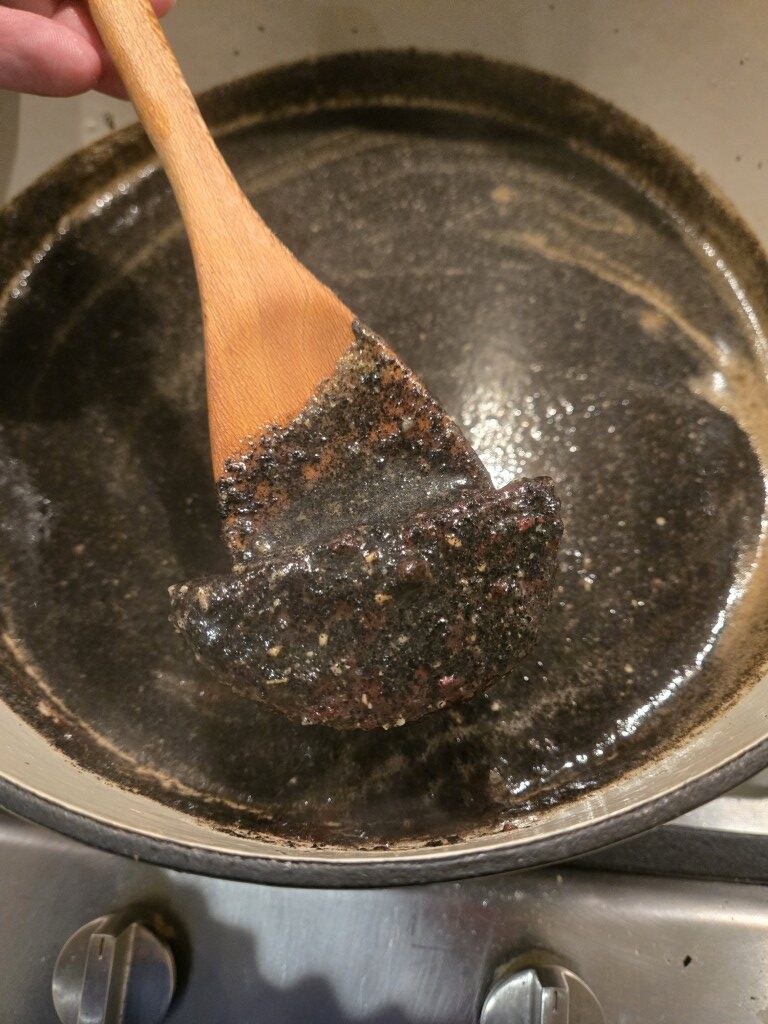
And that’s it! A bit gritty, since we weren’t using an honest to god blender, but the color is beautiful.
None of the recipes for this dish pay the slightest attention to the chicken. “Serve over chicken” is how it’s usually described. So given that, we just got a rotisserie chicken from the neighborhood grocery store. A little rice and beans, a bag of corn tortillas, some Mexican beer, and here’s the final spread:
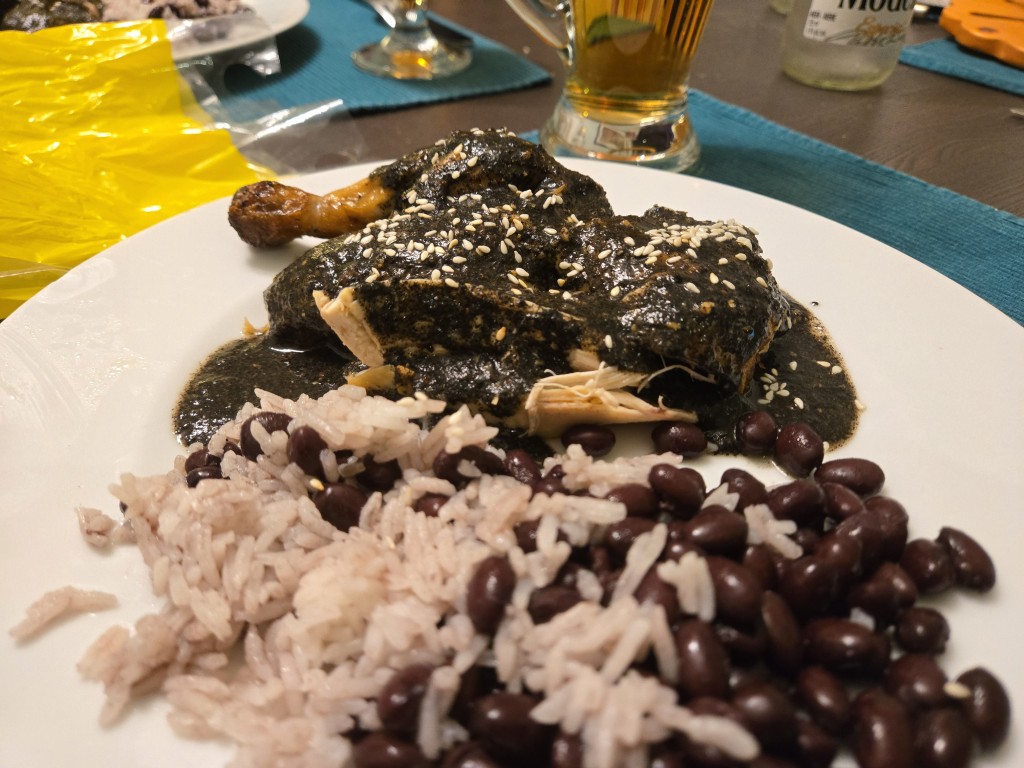
Pretty, innit?
In terms of flavor, it’s obvious what the GOAL was. You could definitely taste the rich complexity of the sauce. But… I think we did burn the chiles a bit too much. I see the approach this recipe was going for, but I think I would have preferred having a bit less burned flavor to try to wash back out. Still – this sauce is a BEAR, and I’m proud of us for even attempting it.
Next up, Jalisco! Home of tequila!
And probably also food, we’ll have to look into that.
Recipe:
https://cooking.nytimes.com/recipes/1023509-mole-negro